
In 2024, the issue of tennis tournament prize money is no longer just a simple ranking among the four Grand Slams. The US Open took the lead in the prize money ranking starting in 2023, and this position was confirmed the following year with a total purse of 75 million dollars. Behind this figure, the hierarchy among the Majors is shifting, and the disparities between the tournaments reflect both the economy of the sport and the competition on the court.
The dollar as an accelerator: why the US Open dominates prize money in 2024
The United States Tennis Association (USTA) has made a clear strategic choice for several years: to increase prize money faster than its European and Australian competitors. As a result, the US Open has been the highest-paying Grand Slam tournament in the world since 2023, with 75 million dollars distributed in 2024.
This amount significantly exceeds what Wimbledon, Roland-Garros, and the Australian Open offer in the same year. The explanation partly lies in the television revenues from the American market, which are considerably higher than those from other markets. Broadcasting contracts in the United States generate sums that allow the American federation to redistribute more to players.
To situate the highest-paying tennis tournament in the global landscape, it is also important to consider that the US Open benefits from a favorable schedule: held at the end of the season, it attracts audiences after the Olympic Games and before the start of the American football championships.

Wimbledon and Roland-Garros: increasing prize money but a structural lag
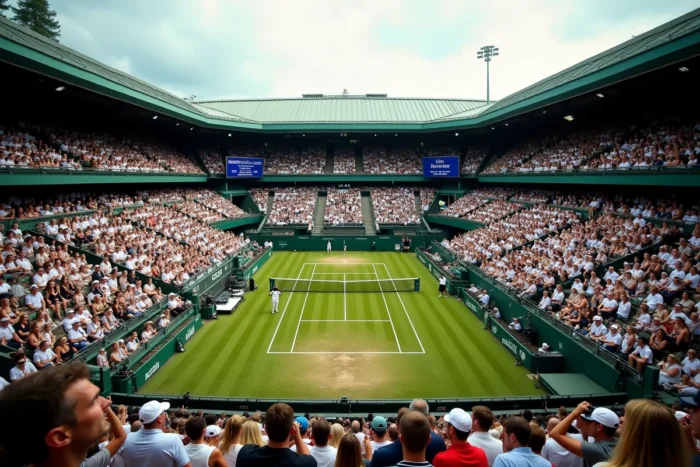
Wimbledon remains the most prestigious tournament in the eyes of many fans. Its prize money has steadily increased, and the organizers announced a record amount for 2026 with 64.2 million pounds (approximately 83 million dollars), representing a 20% increase compared to 2025. In 2024, the London tournament offered around 59.1 million euros according to Challenges, placing it behind the US Open in absolute value.
The gap can be explained by the economic structure of the two events. Wimbledon refuses night sessions and limits advertising on its courts. This model, which contributes to the tournament’s uniqueness, also restricts its commercial revenues compared to Flushing Meadows.
Roland-Garros: clay court progress
Roland-Garros has also increased its prize money in recent years. In 2026, the prize money reaches 61.7 million euros, a record for the Parisian tournament. In 2024, the amount was lower, but the trend remains consistently upward. The French Tennis Federation (FFT) is investing in its infrastructure (retractable roof on the Philippe-Chatrier court, new Simonne-Mathieu court) to generate additional revenue.
The available data does not allow for precise comparisons of the 2024 prize money across all Majors to the nearest cent, as currencies (dollar, pound, euro) fluctuate. What is clear is the hierarchy: US Open at the top, followed by Wimbledon, then the Australian Open and Roland-Garros.
ATP player prize money: what a Grand Slam winner actually earns
Total amounts do not tell the whole story. What interests ATP players and WTA players is the distribution round by round. A player eliminated in the first round of a Grand Slam receives an amount that barely covers their travel, accommodation, and coaching expenses for the fortnight.
- The winner in men’s or women’s singles receives the most visible share, but it represents a fraction of the total prize money (usually between 3 and 5% of the overall purse).
- Players eliminated in the early rounds share a significant portion of the total, a mechanism designed to support players ranked outside the top 50.
- The doubles and mixed doubles draws are significantly less funded than singles, which fuels an ongoing debate about the fairness of the redistribution.
Tennis remains a sport where revenues are highly concentrated. Players like Novak Djokovic, Rafael Nadal, or Roger Federer have accumulated tournament earnings that amount to tens of millions of dollars over their careers. In contrast, a player ranked around the hundredth position in the world struggles to generate a comfortable net income after expenses.
Masters and ATP Finals: prize money that rivals the Grand Slams
The four Majors are not the only tournaments with massive purses. The Masters 1000 (Indian Wells, Miami, Paris-Bercy, among others) and especially the end-of-season ATP Finals offer prize money that approaches that of the Grand Slams, although they do not match the total amounts.
The difference lies in the number of matches: a Grand Slam features 128 players in singles over two weeks, whereas the ATP Finals only host the top eight players of the season. When adjusted for the number of participants, the prize money per player at the ATP Finals is much higher than in any other tournament on the calendar.
An inflation of prize money across the circuit
The increase in prize money is not limited to the top of the pyramid. The ATP and WTA have pushed in recent years for lower-tier tournaments (ATP 250, ATP 500) to also enhance their purses. The stated goal is to reduce the income gap between the top 20 and the rest of the circuit.
The results remain uneven. Some smaller tournaments struggle to keep pace due to insufficient television revenues or sponsors. The question of economic viability for players outside the elite remains open.
The US Open thus retains its position in 2024 as the highest-paying tournament in world tennis, supported by an unparalleled American TV rights market. Wimbledon and Roland-Garros are gradually closing their gap, but currency disparities and economic models maintain a hierarchy that could still evolve in the coming seasons, as evidenced by the spectacular increase announced by Wimbledon for 2026.