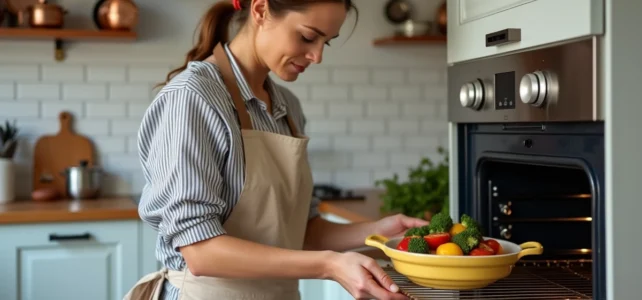
You have a conventional oven, no steam cooker, and you would still like to achieve tender vegetables without drowning them in boiling water. Good news: steaming in a traditional oven requires no specialized equipment. You just need to understand a simple principle and follow a few precise steps to turn your oven into a true steam chamber.
Creating a closed volume in the oven: the principle that changes everything
A dedicated steam oven generates steam thanks to an integrated water reservoir. Your traditional oven, however, does not have this mechanism. To replicate the effect, you need to trap the steam in a closed space inside the oven.
Specifically, this means placing your food in a dish with a small amount of water at the bottom, then covering it tightly. A suitable lid will do the trick. If you don’t have one, a sheet of baking paper placed over the dish, then covered with aluminum tightly around the edges, creates a sufficient seal.
The water at the bottom of the dish turns into steam due to the heat. The steam remains confined, circulates around the food, and cooks it gently. Mastering steaming in a traditional oven relies entirely on this logic of a closed volume.
This way, you achieve a cooking method that is halfway between classic steaming and light braising, without drying out or boiling your food.
Temperature and amount of water: the two settings not to miss
You may have noticed that a covered dish in the oven can yield very different results depending on the chosen temperature? That’s normal. The amount of steam produced and the cooking speed directly depend on these two variables.
What temperature for steaming in the oven
Set your oven between 180 and 200 °C for most vegetables and fish. Below this range, steam production will be too slow. Above it, the water evaporates too quickly, and your food may dry out before it is cooked.
If your oven has a convection mode, prefer it. The circulation of hot air around the covered dish speeds up the water’s temperature rise and ensures even cooking.
The right amount of water in the dish
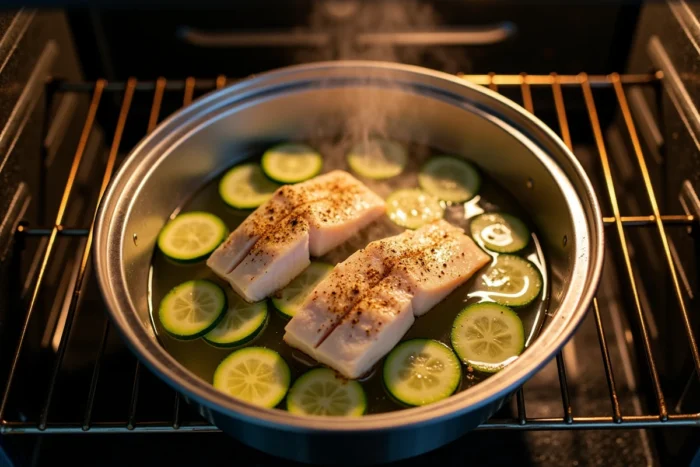
A common mistake is to add too much water. A base of one to two centimeters is sufficient. The goal is not to boil the food, but to produce enough steam to fill the volume under the lid.
- For chopped vegetables (broccoli, cauliflower, carrots), a small amount of water that barely covers the bottom of the dish is enough.
- For a whole fish or a thick fillet, add a bit more water as the cooking time will be longer and evaporation will be greater.
- For root vegetables (sweet potato, turnip, sunchoke), plan for a slightly higher amount as their density requires longer cooking.
Check halfway through cooking that there is still water at the bottom of the dish. If the dish is dry, add a little hot water (not cold, to avoid thermal shock on the dish).
Safety and common mistakes with steam in the oven
Steaming in a traditional oven involves a few precautions that cooking guides rarely mention.
Never spray water on the oven glass
Some bread recipes recommend spraying water in the oven to create steam. If you attempt this technique, always direct the spray towards the walls or the bottom, never towards the glass. The thermal shock between cold water and hot glass can crack or shatter the glass.
This precaution also applies when you open the lid to check the cooking. Open it by tilting it back, so that the steam escapes away from your face and the glass.
Choosing the right dish
Not all dishes can withstand this type of cooking. Avoid unglazed terracotta, which absorbs moisture and can crack. Prefer borosilicate glass, enameled cast iron, or stainless steel.
A dish that is too large for the amount of food disperses the steam and reduces cooking efficiency. Choose a container whose size matches the volume of what you are cooking.
What foods to succeed in steaming in a traditional oven
Steaming in the oven is not suitable for everything. The foods that benefit the most are those that gain from cooking without direct contact with water.
Green vegetables (broccoli, spinach, beans) retain their color, crunchy texture, and nutrients much better than with boiling. Broccoli perfectly illustrates this difference: steamed in the oven, it remains bright green and firm to the bite.
White fish and salmon yield excellent results. The steam cooks them evenly without drying them out, which is often the problem with traditional dry heat oven cooking.
- Green vegetables: broccoli, beans, zucchini, spinach – quick cooking, tender and colorful results.
- Root vegetables: sweet potato, beet, turnip, sunchoke – longer cooking, melting texture.
- Fish and shellfish: fillets, steaks, shrimp – steam preserves moisture without added fat.
- Sourdough bread: steam in the oven enhances the crust and crumb development, a technique used by amateur bakers.
Thick red meats or grilling cuts are not suitable. Steam prevents the Maillard reaction, that golden crust that gives flavor to grilled foods.
Steaming in the oven remains a technique of patience. Expect a few more minutes than with a dedicated electric steamer, as the volume of an oven is larger and the steam rise is slower. The result, however, is nothing to envy specialized devices if you respect the airtight lid and the right amount of water.