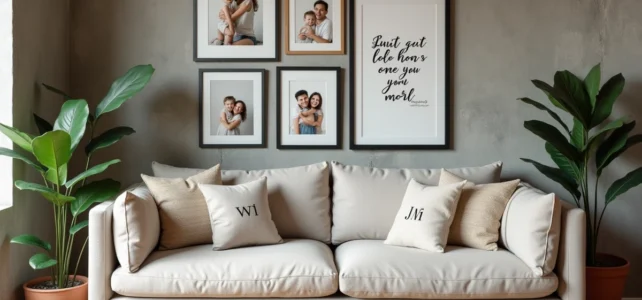
A white wall in a rental living room, a narrow hallway lacking character, a child’s bedroom that looks like no other: personalized decoration addresses specific situations, not a vague concept. Personalizing your interior is primarily about solving a concrete problem, whether it’s hiding a flaw, creating an ambiance, or adapting a space to a lifestyle. Solutions have evolved significantly in recent years, especially for renters and small spaces.
Wall decoration without drilling: the rental constraint as a starting point
We often start here: we move in, the lease prohibits holes, and the walls remain bare for months. Repositionable adhesive systems (photo tiles, sticky frames, hook-and-loop strips) have changed the game. They allow you to personalize a wall without risking a deduction from your deposit.
These solutions are not limited to sticking a photo above the sofa. You can create a real gallery wall, reposition elements with the seasons, and remove everything without leaving a trace. Feedback on long-term adhesion varies depending on the type of wall covering (smooth paint, plaster, wallpaper), but on a clean, smooth surface, adhesion remains reliable for several months.
To explore personalized decoration options suitable for this type of project, you can find ideas at https://www.crea-decor.net/, which brings together various ranges of decorative products.
The main advantage of these devices is their reversibility. You can test a layout, adjust it, and replace one image with another. For a first apartment or temporary housing, it’s personalization without commitment.
Custom acoustic panels: when decor solves a comfort problem
The recent trend worth noting is the emergence of wall panels that combine decoration and sound absorption. In a living room open to the kitchen, an open-plan office, or a bedroom facing the street, noise remains a daily irritant.
Manufacturers now offer acoustic panels printed with custom visuals: landscape photos, geometric patterns, custom illustrations. You get a decorative element that serves a real technical function. This is a use still not widely covered by traditional decor guides, which generally separate aesthetics from comfort.
- Panels made of recycled felt or foam covered with fabric, printable in sublimation with a chosen visual
- Modular formats that can be assembled to cover a variable surface, from a simple decorative square to a full wall
- Attachment possible by clips or adhesives, compatible with rental constraints
Personalizing an acoustic panel addresses two problems in one go: visual ambiance and sound comfort. For a living space or workspace, it’s a relevant compromise.
Child’s bedroom and photo decoration: personalizing without overcrowding
The child’s bedroom is the natural playground for personalized decor. You can put the name on a canvas, family photos, and bright colors. A common pitfall is overcrowding: too many frames, too many colors, too many different themes on the same wall.
A more effective approach is to choose a single axis of personalization per wall. One wall with a mural or custom panoramic wallpaper. Another with two or three wooden photo frames, aligned at the same height. The rest in a solid color.
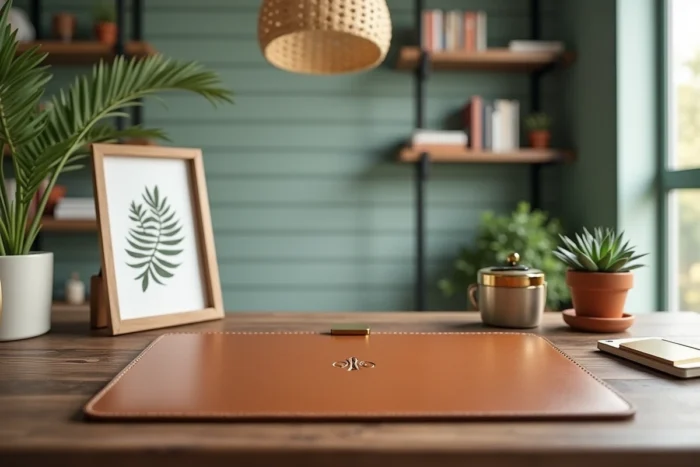
The choice of support is as important as the visual. A canvas printed on cotton has a matte and warm finish, while a photo print under glass gives a more modern effect. For a child’s bedroom, wood and fabric bring softness, while metal or plexiglass are better suited for a teenager’s room looking for a bolder style.
Adapting decor to age without starting over
The child grows, their tastes change. Modular systems (interchangeable frames, posters slid into wall-mounted document holders, repositionable tiles) avoid the need to repaint or patch holes every two years. You replace the visual, not the support.
Gallery wall and arrangement: concrete mistakes to avoid
Creating a gallery wall with photos, illustrations, or decorative objects is one of the most popular personalized decoration projects. You see it everywhere on Pinterest. What you see less are the recurring mistakes that ruin the result.
- Hanging too high: the center of the composition should be approximately at eye level, not at ceiling height
- Mixing too many formats without coherence: combining three or four different formats works, but beyond that, you lose readability
- Neglecting spacing: frames that are too close create a suffocating effect, while those too far apart seem to float without connection
- Forgetting to prepare a paper template before drilling or sticking, leading to visible adjustments
The most reliable method remains to cut paper shapes to the exact dimensions of the frames and fix them to the wall with tape. You can adjust the layout over several days before committing. This step avoids most disappointments.
Materials and supports for durable interior decoration
The choice of material determines the longevity of the finish. A print on brushed aluminum withstands the humidity of a bathroom. A cotton canvas is suitable for a living room or bedroom. An unframed poster without protection will fade within months near an exposed window.
For a personalized interior that lasts over time, prioritize UV-resistant pigment inks and supports suitable for the room’s humidity. This technical detail makes the difference between decor that ages well and one that yellows in a year.
Personalized decoration benefits from being thought of as a technical project as much as an aesthetic one. Support, attachment, light exposure, lease constraints: each parameter guides the choice. An interior that reflects you is one where every decorative element has been chosen for a specific reason, not just because it looked nice on a screen.