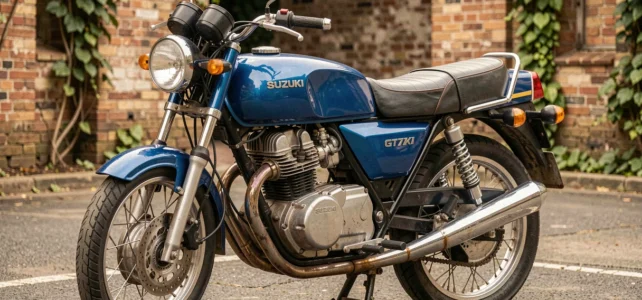
In the classic motorcycle market, the Suzuki 750 GT is often recognized by its color even before reading the badge on the tank. Produced from 1971 to 1977, this touring bike with a liquid-cooled two-stroke three-cylinder engine has gone through several model years, each associated with specific colors and decorative stripes.
Identifying these colors allows one to date a specimen, verify its authenticity, or simply understand why certain versions fetch higher prices than others.
Suzuki 750 GT: why color determines collectible value
Have you ever noticed that the same motorcycle can sell for twice as much depending on its original color? On the 750 GT, this phenomenon is amplified by a simple factor: each model year corresponds to a specific color palette. A tank repainted in a color that did not exist for the year of the frame immediately drops in value in the eyes of a knowledgeable collector.
Current parts catalogs actually distinguish the GT750 by sub-series of model years, not just by calendar year. This fine classification reflects the variations in decor between versions intended for the Japanese market, the American market, or the European market. A 1972 model J sold in Japan did not feature the same stripes as an exported model J.
To learn everything about the Suzuki 750 GT, one must therefore cross-reference the model year code (J, K, L, M, A, B) with the destination market. It is this combination that makes each specimen more or less rare.
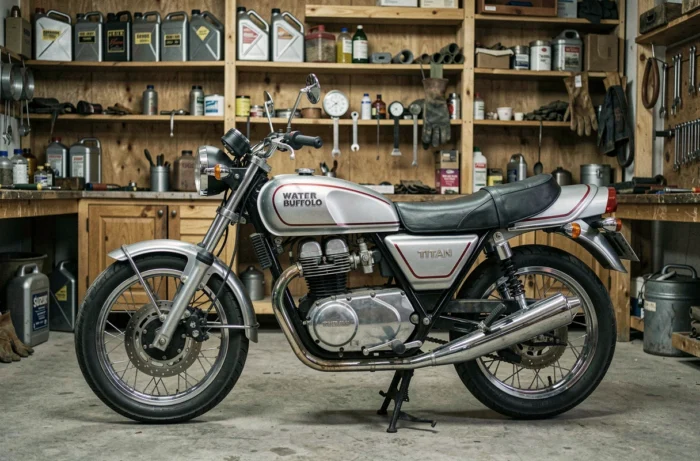
Suzuki 750 GT color palette by model year: from Candy to Metallic Black
The early model years favored bright colors, typical of the early 1970s. The model J from 1972, reserved for the Japanese market with its split headlight, was available in three documented colors:
- Candy Yellow Green (code 289), a very recognizable bright yellow-green, now among the most sought-after colors in collections.
- Pearl Red (code 708), a deep pearlescent red that gave the tank an almost metallic appearance under direct light.
- Pearl Blue (code 707), a pearlescent blue often associated with the classic image of the “Bouillotte,” the French nickname for the 750 GT linked to its liquid cooling.
Starting with the model K (1973), the palette evolved towards more subdued tones. The decorative stripes on the tank and side covers became thinner and more graphic. This trend intensified with the L and M models in the middle of the decade.
The shift to darker shades towards the end of production
The late models (A and B, 1976-1977) mark a clear change. Dark shades replaced the bright colors of the early years. Restored specimens still retain black finishes with fine contrasting stripes today, showing that the collectible market values these versions as well, not just the often-highlighted pearlescent blues.
Identifying an original finish on a Suzuki 750 GT: the details that matter
The color of the tank alone is not enough to authenticate a model year. Several complementary elements come into play, and it is their overall consistency that makes the difference.
- The tape kit (set of decorative adhesive stripes) varies from one model year to another. A model K has different stripes than a model M, even if the base color appears identical.
- The side covers match the tank color but may feature a Suzuki logo of different shape or size depending on the year.
- The front fender, whether chrome or painted is often a neglected clue. On some model years, it matches the tank, while on others it remains chrome.
- Suzuki color codes sometimes appear on a label stuck under the seat or on the frame. When still present, this label is the most reliable source.
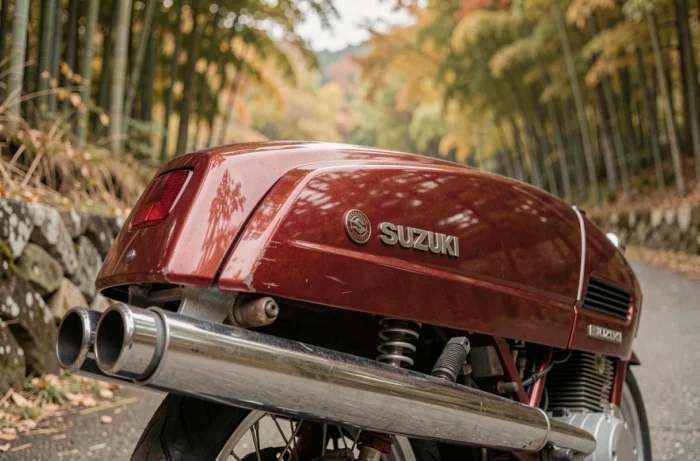
Differences between Japanese and export markets
The Japanese market received exclusive color combinations in the early model years. The Candy Yellow Green of the model J, for example, does not appear in the export catalogs of the same year. Conversely, some shades offered in Europe or the United States did not exist in Japan.
A specimen intended for Japan is also distinguished by its split headlight in the early series. This technical detail, combined with a specific color, helps confirm the geographical origin of a motorcycle with an incomplete history.
Suzuki 750 GT and collectible value: which series are the most sought after
Global production of the GT750 amounted to about 45,000 units over the entire period from 1971 to 1977. This relatively modest volume, combined with the diversity of finishes, creates micro-markets where certain color-model year combinations trade well above average.
The model J in Candy Yellow Green or Pearl Blue ranks among the most coveted. Their rarity stems from both the low volume of the first year of marketing and the fragility of the pearlescent paints, often degraded after several decades.
Late black versions have been gaining value in recent years. Long considered less spectacular than the colorful finishes of the early years, they now attract collectors who appreciate their more understated aesthetics and the quality of finish of the last model years, benefiting from mechanical improvements accumulated over the course of production.
The market remains active enough that recent listings consistently mention color as the main selling point, sometimes even before mileage or mechanical condition. On the Suzuki 750 GT, the paint tells the story of the motorcycle just as surely as its maintenance log does.