
A package shipped from Lyon to Munich has been stuck for four days, the tracking still shows “in transit” without any updates, and we wonder if it’s the strike or just a scanning bug. On the France-Germany route, this situation arises with every major social movement, whether the disruption affects DHL employees, road carriers, or customs. Distinguishing a real blockage from a normal slowdown in tracking changes how we react.
Scan Delay or Real Blockage on the France-Germany Route
When the tracking of a DHL package doesn’t move for two or three days, the first instinct is to conclude that it’s a delay due to the strike. In most cases, the absence of a scan does not mean that the package is immobilized. Tracking updates become less frequent during periods of disruption because the intermediate checkpoints are overwhelmed or operating with reduced staff.
A real blockage is recognized differently. If the last scan locates the package at a specific hub (for example, a sorting center in the Paris region or at the border) and this status persists beyond four to five business days, we are likely facing a physical immobilization. A simple slowdown in scanning often shows an initial pickup event followed by silence, then the package reappears directly at its destination or at German customs.
To better understand DHL delivery times between France and Germany during a strike, we can compare the tracking behavior of a domestic French shipment (where each step is scanned on the national network) and an international shipment (where only departure and arrival at customs generate a visible event).
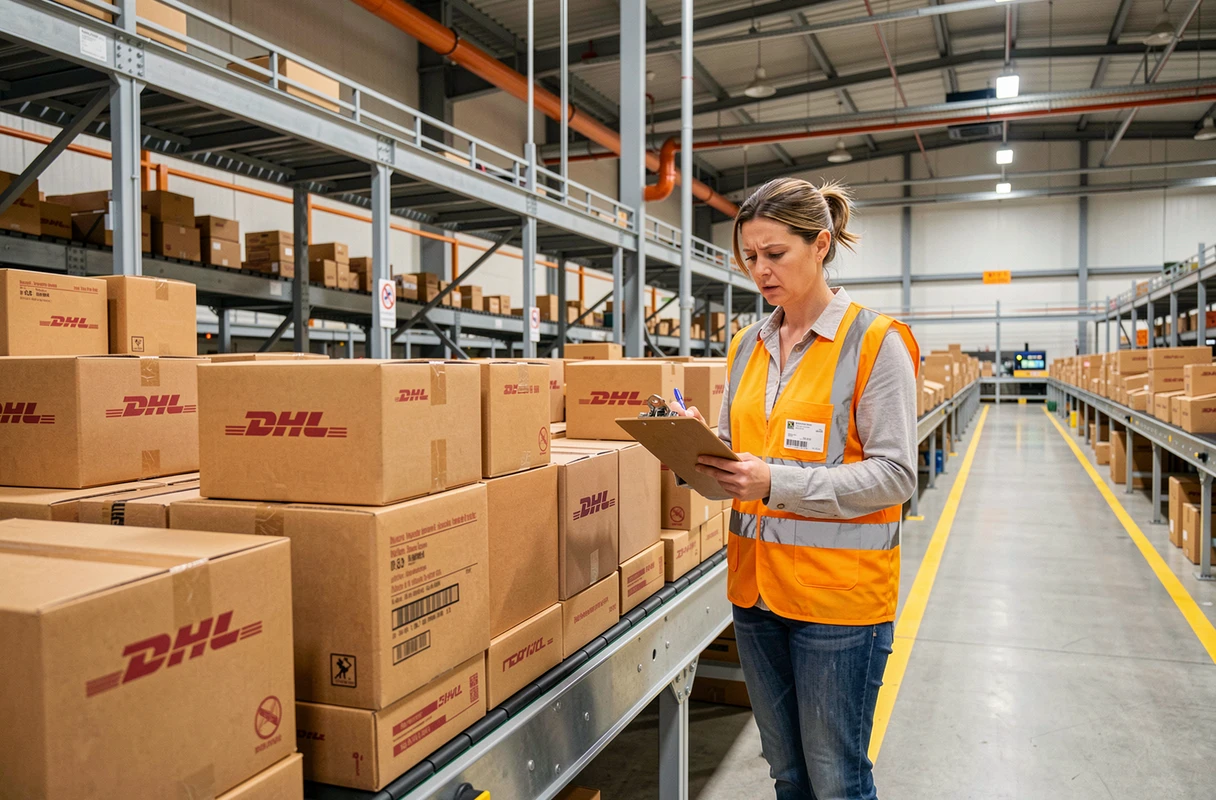
Which Link in the DHL Chain Causes Delays Between France and Germany
It is often thought that the strike affects the entire network uniformly. In reality, the delay depends on the specific link that is disrupted. On the France-Germany axis, three segments can slow down independently of each other.
- Sorting at departure in France: if the collection hub is affected, the package does not leave the territory. The tracking remains stuck on “shipment recorded” or “in processing.” This is the most visible and frustrating scenario.
- Cross-border road transport: freight flows crossing France or using corridors to Germany can be slowed by roadblocks without DHL itself being on strike. The package moves forward, but slowly, and the intermediate scans disappear.
- Distribution on the German side: rarer during a French strike, but when a social movement also affects German hubs (as has happened in Leipzig), the package arrives in Germany and then stagnates in the last mile.
In practice, an express shipment that bypasses the disrupted hub through air rerouting can arrive within the usual timeframes, while a standard road package on the same route accumulates several days of delay.
Express or Standard: The Chosen Service Makes All the Difference
DHL Express generally maintains priority on its premium shipments, even during a strike. Express flows use more air freight and dedicated sorting circuits, making them less vulnerable to local blockages. DHL eCommerce or Parcel shipments, which go through shared networks, are the first to experience delays.
An express package can arrive on time while a standard shipment takes three to five days longer on the same route. Returns vary on this point depending on the periods, but the trend remains constant: the level of service paid determines resilience to disruptions.
DHL France-Germany Delivery Times During Strikes: What Can Be Expected and What Cannot
The delivery times published by DHL for a France-Germany shipment are indicative benchmarks, not absolute contractual commitments. During a strike, DHL shifts the delivery promise without canceling the shipment. The package eventually arrives, but the initially displayed date no longer holds value.
Since 2025, DHL has tightened its customer contact channels, complicating information requests in case of disruption. Getting an operational response on a blocked package takes longer than before. Online tracking remains the most reliable channel, provided one knows how to read its silences.
Three Concrete Reflexes When Tracking Stops Moving
Before contacting customer service, one can already draw conclusions from the tracking itself.
- Check the location of the last scan: if the package has passed through customs or left French territory, it is likely moving forward despite the lack of updates. The next scan will appear on the German side.
- Compare with DHL service alerts: the carrier’s alert page reports disruptions by country and service type. If France is listed with a mention of delay, the blockage is confirmed on the network side.
- Wait at least five business days after the last scan before opening a claim. Below this timeframe, DHL generally considers that the shipment is still within the tolerance margins of a disrupted delivery.

Customs and Strikes: A Double Slowdown on France-Germany Packages
On an international shipment, customs adds a layer of complexity. When sorting is disrupted on the French side, customs documents can also be delayed. A package without complete customs data remains blocked even if transport resumes.
Between France and Germany, customs formalities are simplified by the European single market for most goods. However, certain products subject to specific duties or health checks go through verification circuits that operate slowly when staff are on strike.
The classic trap: a package of jewelry or handmade products shipped with an incomplete declaration. Normally, the inspection passes quickly. During a strike, the same package can remain pending verification for several additional days, not due to transport, but because administrative processing is slowed down.
On the France-Germany axis, the best strategy remains to ship with complete documents and an express service as soon as a social movement is announced. The additional cost of the premium service is justified when the cost of a delay exceeds the difference in price between a standard shipment and an express shipment.