
A French size 38 in ready-to-wear corresponds to a waist measurement of around 68 to 70 cm according to most size charts. This figure, referenced by many brands, provides a useful ballpark but masks a more complex reality. The measurement depends on the exact point where the tape measure is placed, the brand consulted, and the type of garment targeted.
Waist measurement for a size 38: what size charts really measure
The confusion begins with the measurement itself. Some brands ask to place the tape measure at the narrowest point of the bust, under the ribs. Others direct the measurement towards the natural waist, or even towards the actual wearing area of the belt.
Nike, for example, specifies that the waist should be measured at the narrowest point, while other brands use the garment’s waistband as a reference.
This difference in protocol means that the same person can obtain two distinct measurements, separated by several centimeters, depending on where they place the tape. For a high-waisted garment (fitted dress, high-waisted skirt), the relevant measurement will be at the narrowest point. For low-rise jeans, the measurement at the level of the hips or low waistband is what counts.
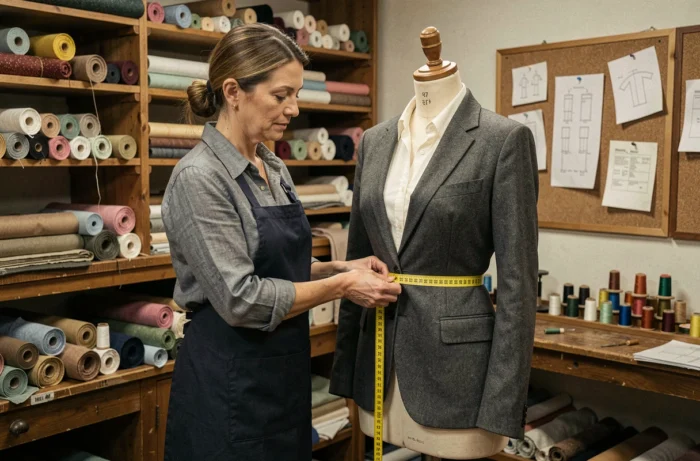
The act of measuring itself influences the result. One should stand upright, feet together, back straight, without thick clothing, with the tape resting directly on the skin without compressing. Repeating the measurement at the same spot each time remains the only way to obtain reliable tracking. A two-centimeter shift up or down is enough to switch from one size to another in certain charts.
To delve deeper into these correspondences, consulting the measurements for women’s size 38 on Perceptum allows for cross-referencing data from several references.
Size 38 correspondence: why brands do not agree
The size charts of French and international brands do not rely on a single standard. A size 38 at La Redoute, Promod, Muji, or New Balance refers to slightly different measurement ranges. The label alone is not enough to determine a reference waist measurement.
Several factors explain these discrepancies. Brands calibrate their patterns on target morphotypes that vary according to their positioning (sportswear, classic ready-to-wear, plus-size fashion). The choice of fabric also plays a role: a stretchy jersey accommodates a wider range of measurements than a rigid canvas.
The most useful size guides for a size 38 actually combine several measurements, not just the waist. Bust, hips, and inseam contribute to the overall fit of the garment. A waist measurement of 69 cm associated with a hip measurement very different from the standard value of the chart may lead to another size or a different cut.
Typical size 38 correspondence chart
| Measurement | Indicative range for size 38 |
|---|---|
| Bust measurement | Approximately 86-88 cm |
| Waist measurement | Approximately 68-70 cm |
| Hip measurement | Approximately 94-96 cm |
These values are indicative. In practice, comparing one’s own measurements to the chart of each brand remains more reliable than relying on a generic equivalence.
Waist measurement and health: an indicator not to be confused with clothing size
The waist measurement is also treated as a standalone health indicator, independent of the clothing size worn. Health recommendations set risk thresholds related to the accumulation of abdominal fat, particularly for cardiovascular diseases and diabetes.
For women, a waist measurement exceeding 80 cm is associated with an increased risk according to commonly used public health thresholds. This benchmark has no relation to clothing size: a woman wearing size 38 with a waist measurement of 70 cm is well below this threshold. The medical data and the clothing data answer two distinct questions.
Confusing the two leads to frequent misunderstandings. The clothing waist measurement measures a body dimension to adjust a pattern. The medical waist measurement assesses the distribution of fat mass to estimate risk. The measurement methods sometimes differ (mid-distance between the last palpable rib and the iliac crest for the medical approach), and the data are not interchangeable.
- The clothing measurement is taken at the narrowest point of the bust or at the waistband level depending on the brand.
- The medical measurement is taken halfway between the last palpable rib and the top of the hip bone.
- A gap of several centimeters between the two protocols is common for the same person.

Finding your size 38 without relying on a single number
The most reliable approach is to take your three main measurements (bust, waist, hips) with a flexible tape measure, and then compare them directly to the charts of the targeted brand. Taking your measurements before each online order avoids returns related to variations between brands.
The waist measurement alone tells only part of the story. Two people with an identical waist measurement of 69 cm may wear different sizes if their hip or bust measurements diverge. Brands that offer cross-referenced correspondences (size, hips, bust, inseam) provide a significantly more accurate fit than a simple one-entry chart.
The figure of 68 to 70 cm for a size 38 remains a reasonable starting point, not an absolute truth. Charts vary, body shapes do too, and the only reliable constant remains the measurement taken at home, compared to the chart of the chosen brand.