
Vermogal is an antiparasitic gel marketed in Morocco, classified as an over-the-counter medication and dispensed without a prescription at pharmacies. Its popular use for promoting hair growth circulates widely on forums and social networks, but this practice relies on a diversion from the product’s initial function. Vermogal for hair has no market authorization for hair use, raising concrete safety concerns.
Vermogal: an antiparasitic diverted from its official indication
Vermogal is formulated as a medication intended to treat parasitic infestations. Its classification as over-the-counter medication in Morocco means it can be sold without a prescription, but within a specific framework: that of antiparasitic treatment. The pharmacist who dispenses it assumes professional responsibility regarding the recommended use.
The hair use of Vermogal is not based on any published clinical data. No referenced medical review has documented a beneficial effect of this product on hair growth or quality. Word of mouth, fueled by testimonials on social media, serves as the only “evidence” – which, in pharmacology, does not constitute an acceptable level of proof.
Understanding the dangers and use of vermogal requires clearly distinguishing the regulatory status of the product and the hair claims attributed to it without scientific basis.
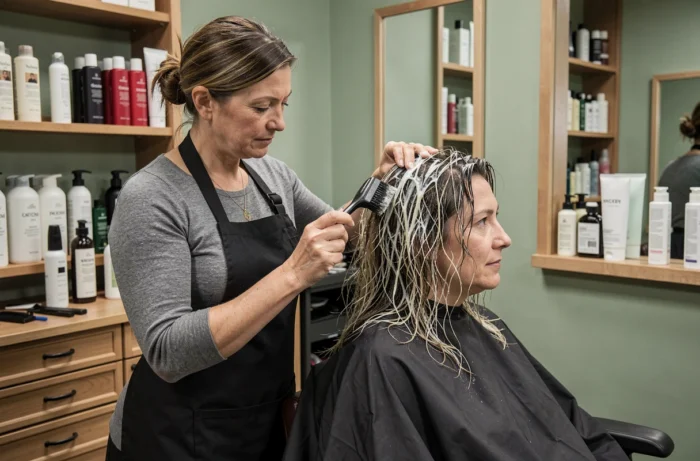
Adverse effects of antiparasitics applied without medical indication
Using a dewormer or antiparasitic outside of its indication exposes users to adverse effects that are not limited to the application area. Antiparasitics, even in the form of a topical gel, contain active ingredients designed to act on living organisms. Repeatedly applied to the scalp without therapeutic necessity, they can cause local and systemic reactions.
Field reports vary on this point: some users report a temporary improvement in hair appearance, while others describe scalp irritations, persistent itching, or episodes of flaking. The available data do not allow for a conclusion of a favorable benefit-risk ratio for hair use.
Documented risks for diverted antiparasitics
Adverse effects associated with antiparasitics used without medical indication include several categories of disorders:
- Local skin reactions: irritation, redness, dryness, or flaking of the scalp, which may worsen existing hair loss rather than alleviate it
- Digestive disorders (nausea, vomiting, diarrhea) in cases of prolonged exposure or accidental ingestion, especially in children
- Neurological and hepatic risks reported in the literature on dewormers taken without necessity, according to medical popularization sources
- Allergic sensitization: repeated contact with an active ingredient not intended for cosmetic use can trigger delayed allergic reactions, which are difficult to identify
Diversion of a medication from its basic function carries a backlash effect, as several pharmacists point out on specialized forums. The scalp is not a neutral area: it is a vascularized tissue that absorbs some of the substances applied.
Hair care: documented alternatives to vermogal
The hair care market offers active ingredients whose effectiveness on hair growth or quality has been evaluated. These alternatives do not share the risk profile of a diverted antiparasitic.
Vegetable oils and hair masks
Vegetable oils (coconut oil, argan oil, castor oil) have been used for generations to nourish hair fibers and protect the scalp. Their application as a mask before rinsing does not present systemic risk. Coconut oil, in particular, has been the subject of publications showing its ability to reduce protein loss from hair during washing.
Hair masks based on vegetable oils act on hydration and mechanical resistance of the hair. They do not claim to accelerate growth but help limit breakage, giving the appearance of longer and denser hair over time.
Hair-targeted active ingredients under medical supervision
For individuals facing pathological hair loss, treatments with market authorization exist. Minoxidil in topical solution, for example, is marketed with a specific indication for alopecia. This product has its own side effects (local irritation, hypertrichosis, and in rare cases cardiovascular effects), but its benefit-risk ratio has been evaluated by health authorities.
The fundamental difference between an authorized treatment and a diverted antiparasitic lies in this evaluation: a product like minoxidil has undergone clinical trials, while Vermogal used on hair has never been subjected to this process for this use.

Vermogal and hair: what the regulatory framework says
A medication classified as over-the-counter must meet specific criteria: it treats benign conditions identifiable by the patient, and its use is governed by the package insert. No Vermogal package insert mentions a hair indication. Therefore, applying this product to the scalp to stimulate growth constitutes off-label use, not covered by the manufacturer.
In the event of an adverse effect related to off-label use, the responsibility of the manufacturing laboratory is not engaged. The user alone bears the consequences of a use not in accordance with the package insert. The pharmacist who would actively advise this diversion would also expose themselves to ethical questions.
Safety checks of cosmetic products in France, documented by the competent authorities, regularly reveal non-compliance in commercial hair products. Using a medication not evaluated for this use adds an additional layer of risk to an already monitored sector for its excesses.
Vermogal remains an effective antiparasitic for its indication. Its diversion for hair use is based on unsubstantiated beliefs and exposes users to side effects without demonstrated benefit. Hair care has evaluated alternatives, from classic vegetable oils to regulated medical treatments, which do not involve the risk of applying a medication where it has never been tested.