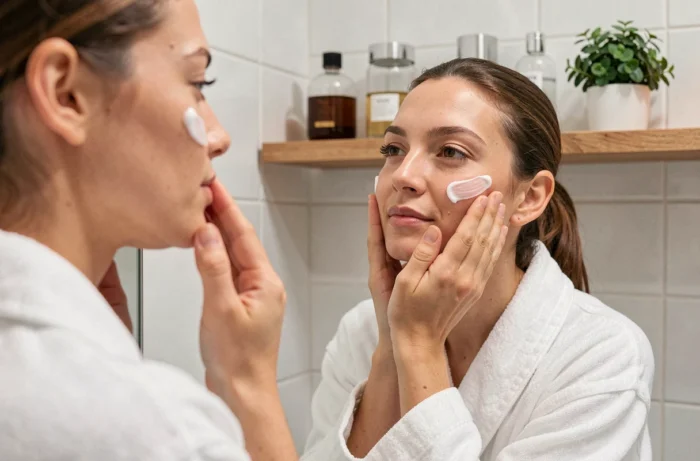
The quality of the skin depends on a balance between external and internal factors: UV exposure, composition of applied products, hydration, diet, sleep. Measuring the real impact of each parameter allows for prioritizing the actions that matter for taking care of your skin on a daily basis, rather than piling up routines without distinguishing what produces a measurable effect from what is merely marketing.
Reliability of the SPF index: what the EN ISO 23675:2024 standard changes
Most content on sun protection limits itself to recommending an SPF of 30 or 50 without questioning the method behind that number. Since the end of 2024, a new international standard, EN ISO 23675:2024, validated by the European Union, allows for measuring the SPF index of sunscreens through in vitro tests, without exposing human volunteers to UV.
This evolution has a direct impact on the choice of your daily sunscreen. The reliability of the displayed SPF index increasingly relies on standardized in vitro methods, which strengthens the consistency between the number on the bottle and the actual protection.
On the other hand, certain formats like sticks or powder sunscreens are still less well covered by these new standards. For daily facial sun protection, creams and fluids offer better-documented coverage than compact formats, which are often chosen for their practicality but whose actual effectiveness is harder to standardize.
Choosing products whose SPF has been evaluated according to rigorous protocols is part of the concrete actions to preserve your skin, well before adding a serum or an additional treatment to your routine. Resources like Un Temps Pour Ma Peau allow for a deeper exploration of these formulation questions and help choose care suitable for each skin type.

Sun protection and melanoma prevention: the real hierarchy of actions
Popular articles place sunscreen at the center of skin cancer prevention. French health authorities provide a nuance that is rarely relayed: sunscreen is not the first line of defense against melanoma. Avoiding direct exposure during peak hours and wearing covering clothing take precedence over applying sunscreen.
This point changes how one builds a daily skincare routine. Applying SPF 50 cream does not compensate for prolonged exposure between noon and 4 PM. The table below summarizes the recommended hierarchy.
| Protective Action | Priority Level | Context of Effectiveness |
|---|---|---|
| Avoid exposure during peak UV intensity hours | First | All year round, reinforced in summer |
| Covering clothing, hat, sunglasses | Second | Prolonged outdoor activities |
| Broad-spectrum sunscreen (UVA/UVB) | Third | Exposed areas not covered by clothing |
| Monitoring the daily UV index | Complementary | Adjust protection according to actual weather |
This hierarchy means that sunscreen remains a complement, not a substitute for avoiding exposure. A simple reflex is to check the UV index of your city every morning to adjust your protection before going out.
Facial cleansing and product choice: what really alters the skin barrier
Cleansing the face morning and evening is widely agreed upon. What distinguishes an effective routine from a counterproductive one is the pH of the product used and the frequency of exfoliation.
- A neutral or slightly acidic pH cleanser (close to the skin’s natural pH, around 5.5) preserves the hydrolipid film. Classic soaps, often alkaline, weaken this barrier and promote dryness.
- Mechanical or chemical exfoliation, limited to once or twice a week, is sufficient to remove dead cells without causing micro-lesions on sensitive skin.
- Excessive cleansing degrades the skin barrier as much as lack of cleansing: two daily passes with a gentle product constitute the recommended framework.
The choice of cleansing product has more impact on skin health than adding a serum or a weekly mask. For oily skin, a foaming, soap-free cleanser reduces excess sebum without triggering compensatory overproduction.
Skin hydration and water: distinguishing measurable effects
Drinking enough water contributes to the overall hydration of the body, but skin hydration primarily depends on the skin’s ability to retain water, not just the amount ingested. The difference between dehydrated skin and properly hydrated skin lies in the integrity of the skin barrier and the application of an occlusive or humectant treatment.
A moisturizer applied to slightly damp skin, just after cleansing, traps water in the epidermis. This action, repeated morning and evening, produces a visible effect on skin comfort within a few days, whereas merely increasing water intake has not been shown to have an effect on the hydration of the stratum corneum.

For the body, areas prone to dryness (elbows, shins, hands) benefit from richer formulas than those intended for the face. Applying after a shower, when the skin is still damp, increases the penetration of moisturizing agents.
Sleep and cellular regeneration
The regeneration of skin cells accelerates during sleep. Chronic sleep deprivation results in a dull complexion, loss of elasticity, and slowed healing. This factor, often relegated to the bottom of the list in skincare guides, affects skin quality in a way comparable to the application of a daily topical treatment.
Caring for your skin involves as much sleep and sun protection as it does the products applied. The most effective actions are also the least costly: getting enough sleep, limiting direct UV exposure, cleansing without aggression, hydrating on damp skin. The simplest routine, based on these four pillars, produces more stable results than an accumulation of poorly prioritized treatments.