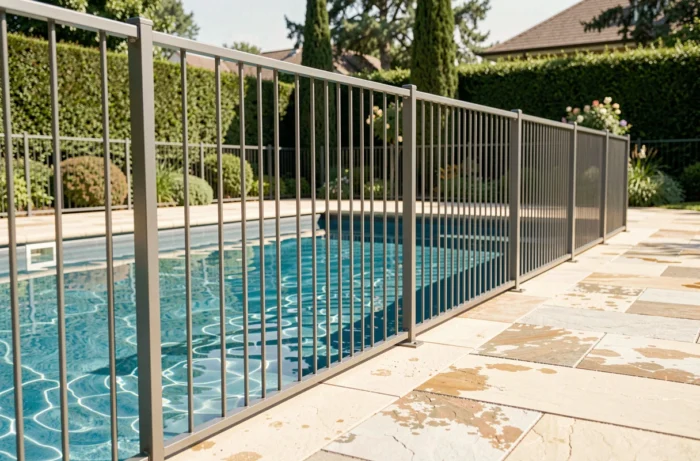
On a gently sloping terrain, with a coping that extends a few centimeters above the ground, the height of a pool barrier is not measured as one might imagine. The starting point for the measurement changes depending on the configuration of the ground, and this is precisely where most installations encounter problems during an inspection.
Measuring the height of a pool barrier: the trap of the support point
The NF P90-306 standard sets a minimum height of 1.10 meters. However, this measurement is not simply taken from the ground to the top of the panel. The height of 1.10 meters must be measured between two support points, that is, between the highest support point on the outside (where a child could place their foot) and the top of the barrier.
Specifically, if a horizontal rail, a low wall, or a planter edge is at the foot of the fence on the access side, it is from this point that the measurement is taken. A barrier showing 1.20 meters from the ground can fall below the regulatory 1.10 meters if a relief element serves as a foothold for a child under five years old.
This problem is frequently encountered with barriers placed on elevated terraces or along decorative walls. This detail explains why some models sold as compliant are no longer so once installed on site. To delve deeper into this topic, the height standards for pool barriers on Deco Asaiss detail common scenarios.

Garden fence and pool barrier NF P90-306: two different requirements
An existing garden fence, even if it is 1.50 meters high, does not automatically replace a barrier compliant with the NF P90-306 standard. The difference lies in three technical criteria that most classic fences or panels do not meet.
- The spacing between elements (bars, slats, meshes) must prevent the passage of a spherical object larger than 10 cm in diameter, which excludes many wide-mesh fences.
- The structure must offer no footholds or climbing aids on its entire height on the outside, which eliminates fences with accessible horizontal rails.
- The fence must be associated with a compliant gate, with automatic closure and locking, whose opening requires at least two distinct actions.
In practice, feedback varies on this point: some rigid fences with vertical bars spaced less than 10 cm pass inspection if they include a compliant gate. Others, however sturdy, fail due to a simple horizontal rail at mid-height.
Pool safety gate: the weak link in installations
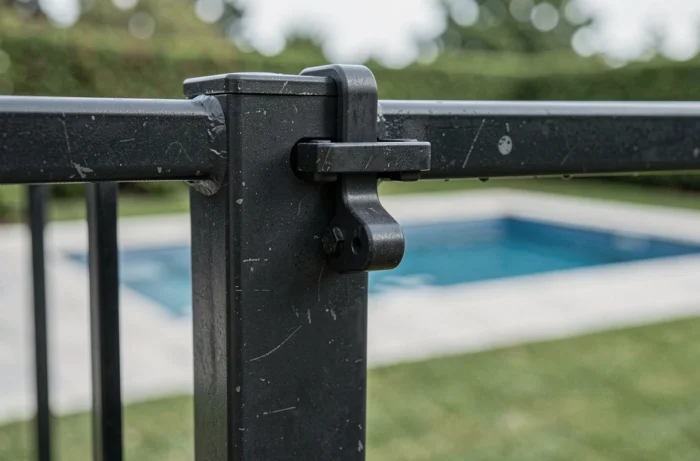
The height of the barrier attracts all the attention, but the gate accounts for the majority of non-compliance issues observed on site. The NF P90-306 standard requires a mechanism for automatic closure and locking. When the gate is released, it must close by itself and lock without intervention.
Opening requires at least two simultaneous or successive actions. A simple latch that is lifted with one hand is not sufficient. We are talking about double-action mechanisms, often placed high to remain out of reach of a child under five years old.
Common mistakes regarding the gate
The low-quality magnetic gate loses its magnetism after a few seasons of exposure to the elements. There are also hinges that seize up, preventing automatic closure. A gate that no longer closes by itself renders the entire barrier non-compliant, regardless of its height.
Another overlooked point: the space under the gate. If it exceeds the ground spacing limit, a young child may attempt to slip underneath. Therefore, the verification is not limited to the main panel.
Sanctions and liability in case of non-compliant pool barrier
Failure to comply with the obligation to secure a private in-ground or semi-in-ground pool exposes one to a fine of up to 45,000 euros. This penalty targets the owner, whether they occupy the property or rent it out.
Beyond the fine, civil and criminal liability comes into play in the event of an accident. A barrier that is present but non-compliant (insufficient height, faulty gate, too wide spacing) does not legally protect the owner. Insurers examine compliance with the NF P90-306 standard before any coverage.
What the law actually requires
The pool safety law concerns all private outdoor pools, whether in-ground or semi-in-ground. Above-ground pools are not subject to this obligation unless they are partially embedded in the ground. Four safety devices are recognized: barrier, alarm, cover, and shelter. Only one of these devices is sufficient, but it must comply with the corresponding standard.
The barrier remains the most commonly chosen device because it provides permanent physical protection, active even in the absence of supervision. An alarm sounds after immersion, while a barrier prevents access beforehand.
The key point for any installation: verify compliance on site, not from a catalog. The actual height between support points, the functioning of the gate after a few months of use, and the absence of climbing aids are the three checks to redo each season before the pool opens.