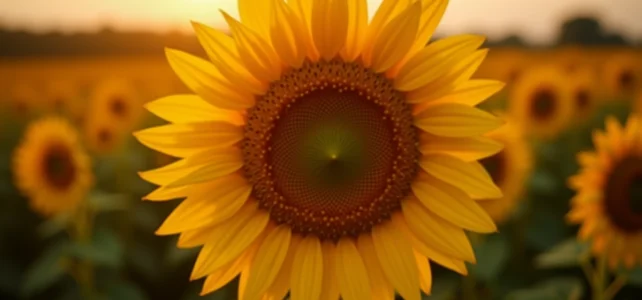
Giving a sunflower is to convey a bright message without needing to explain it. This flower with golden petals speaks for itself: it evokes warmth, good cheer, and a form of enthusiasm for life. But behind this sunny image lie layers of deeper meaning, related to loyalty, resilience, and even a concrete ecological role.
Heliotropism of the sunflower: a mechanism that nourishes the symbol
Have you ever noticed that young sunflowers follow the sun from morning to evening? This behavior has a name: heliotropism. It relies on growth hormones, auxins, which accumulate on the shaded side of the stem. The imbalance causes the plant to bend toward the light.
This movement does not last for the entire life of the flower. Once blooming is achieved, the stem stiffens and the flower head remains oriented toward the east. The plant thus captures the first rays of morning, which warms its flowers more quickly and attracts more pollinators.
It is precisely this biological mechanism that has established the meaning of the sunflower in the language of flowers as we know it. A flower that turns toward the light naturally becomes a symbol of constancy and hope. The image is not arbitrary: it directly stems from the living.

Sunflower and loyalty: the myth of Clytie in ancient Greece
Greek mythology has given the sunflower its strongest emotional charge. The nymph Clytie, in love with Apollo, the sun god, never received his love in return. After nine days spent watching the sky without eating or drinking, she transformed into a flower that constantly turns toward the sun.
This legend anchors the sunflower in a specific register: unconditional loyalty, even if unreciprocated. Giving a sunflower, in this interpretation, is to express deep and lasting admiration. The love is there, but it does not seek to possess.
This story explains why the sunflower has never been confined to classic romantic bouquets. It also expresses solid friendship, familial attachment, or respect for someone admired. The emotional palette is broader than a red rose, and that is what makes it a versatile flower in the language of flowers.
Number of sunflowers given: what each bouquet communicates
In floriography, the quantity of flowers alters the message. The sunflower is no exception to this rule, even if the codes are more flexible than for roses.
- One single sunflower expresses targeted admiration, a crush, or a sincere tribute to a specific person
- A small bouquet of three to five stems conveys shared joy, warm friendship, or generous thanks
- A mixed bouquet, combining sunflowers and complementary flowers (lavender, thistle, grasses), creates a composite message where the sunny dominance of the sunflower remains readable but is enriched with nuances
Why does this detail matter? Because a single sunflower in a vase makes a strong graphic impact, almost sculptural. The message is direct. A composed bouquet softens the statement and is better suited for contexts where one wants to express a collective emotion.

Sunflower and ecological resilience: a contemporary symbol
The meaning of a flower evolves with the times. In recent years, the sunflower has gained a new dimension in agricultural and environmental discourses. Agricultural innovation platforms visited by public authorities in 2025-2026 present it as a resilient plant, suited to French soils and offering opportunities for food.
This image of resilience in the face of climate change extends the traditional symbolism. The sunflower no longer only represents joy: it also embodies the ability to hold firm when conditions become harsh. It is an optimism rooted in reality, not in naivety.
Sunflower and biodiversity: a nectar-rich flower for pollinators
The sunflower is among the nectar-rich flowers recommended by pollinator protection associations. Bees, bumblebees, and butterflies find in its large flower heads an abundant source of nectar and pollen.
This concrete ecological function adds a layer of meaning to the flower. Giving a sunflower is also choosing a flower that nourishes life. In a context where the disappearance of pollinating insects is a concern, this detail is not trivial. The sunflower becomes a symbol of care for the ecosystem, not just for the person receiving it.
Color of sunflowers and variations in meaning
The classic sunflower, bright yellow with a brown center, remains the most symbolically charged. It carries the essence of the message: joy, warmth, loyalty. But the palette of this flower has expanded with horticultural selection.
- Orange or copper varieties evoke energy, gentle passion, an admiration tinged with intensity
- Cream or pale lemon sunflowers carry a more delicate message, suitable for ceremonies or understated tributes
- Dark red varieties, rarer, introduce a note of emotional depth close to gratitude or remembrance
The color does not replace the gesture, but it refines it. Choosing a dark red sunflower for a funeral or a bright yellow sunflower for a birth is not the same language. The chromatic nuance specifies the intention without verbalizing it.
The sunflower remains one of the few flowers whose symbolism works in both joyful contexts and more serious moments. Its imposing size, upright posture, and ability to capture attention give it a presence that few flowers can match. The message it carries, from silent admiration to collective resilience, adapts to both the giver and the receiver.