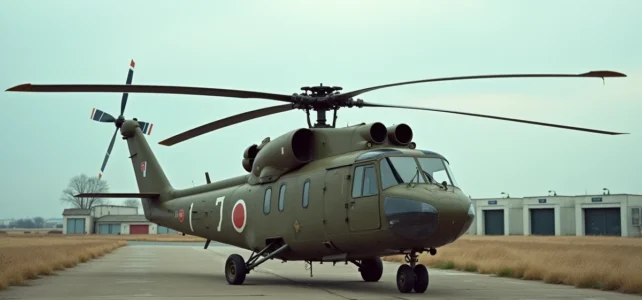
The Army Light Aviation (ALAT) is undergoing an unprecedented renewal phase. Three major programs overlap: the ramp-up of the NH90 Caïman, the arrival of the H160M Guépard, and the integration of remotely operated munitions on the Tiger. This overlap redefines the French air combat doctrine well beyond the simple replacement of aging airframes.
Remotely Operated Munition Toutatis and Tiger: Striking Beyond the Line of Contact
The Ukrainian feedback has accelerated a shift that ALAT had been considering for several years. Exposing an attack helicopter within the firing range of short-range surface-to-air systems is too costly in terms of risk and attrition. The technical response involves the remotely operated munition Toutatis developed by Thales, capable of striking beyond thirty kilometers without the Tiger approaching the engagement zone.
We are witnessing a paradigm shift here: the Tiger is transitioning from a direct attack helicopter role to that of a launch platform. The crew designates, the loitering munition executes. This decoupling between the vector and the effector extends the strike chain while reducing the exposure of the airframe and its crew.
To delve deeper into the history and missions of French military helicopters on Communiqués du Net, the journey of the Tiger since its entry into service illustrates this trajectory of continuous adaptation.
The operational stakes go beyond mere range. The remotely operated munition allows for firing from a terrain mask, behind a ridge, or a forest edge. The Tiger no longer needs to rear up to acquire its target. Air combat becomes indirect, modeled on artillery logic.
H160M Guépard: Industrial Breakthrough in Fleet Rationalization
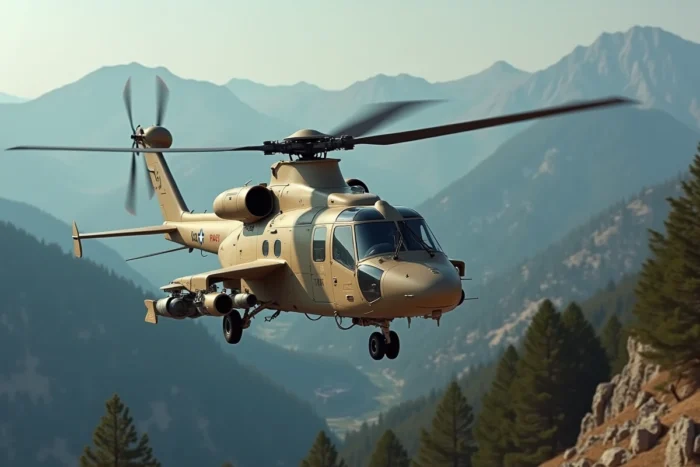
The Guépard program is not just about replacing the Gazelle, Dauphin, Panther, and Fennec with a single platform. It imposes an unprecedented joint logic for a French light helicopter. The Army, Navy, and Air Force share the same basic airframe, the civil H160 from Airbus Helicopters, adapted into versions for each service.
The DGA announced the success of an initial firing campaign in cooperation with Airbus Helicopters at the Cazaux site. This milestone confirms that the Guépard has surpassed the demonstrator stage. The first prototype has flown, armament trials are underway, and the results validate the choices for weapon integration on a converted civil airframe.
This rationalization addresses a concrete problem: ALAT and other airborne components previously maintained five or six different types of light aircraft, each with its own logistics chains, pilot training curricula, and spare parts stocks. The Guépard reduces this dispersion.
What the Guépard Changes for Maintenance in External Operations
In a theater like the Sahel or French Guiana, the technical availability of a heterogeneous fleet drops rapidly. Fennec parts do not fit the Gazelle. A mechanic trained on the Dauphin cannot work on the Panther without additional qualification.
With the Guépard, a single skill set covers the entire light fleet. The gain is measured in availability rates, not just unit cost. This is the true industrial argument of the program.
Caracal in French Guiana: Capability Renewal in Jungle Theater
The first Caracal EC 725 helicopters have been delivered to French Guiana to replace the aging Puma helicopters. This deployment is not trivial. The Guiana theater imposes specific constraints that competitors often overlook:
- Extreme humidity that accelerates corrosion of airframes and degrades non-tropicalized avionics systems
- Absence of ground infrastructure in most operational areas, requiring high logistical autonomy and reliable autorotation capability in case of engine failure above the canopy
- Operations against illegal gold mining requiring rapid tactical transport with hoisting capability under dense forest cover
The Caracal provides more powerful engines, greater range, and navigation systems suited for flight in degraded environments. This replacement enhances projection capability in overseas territories, where the operational wear of the Puma had become critical.
Future Combat Doctrine and Man-Drone Integration
The Army has integrated its helicopters into the “future combat” transformation program. Ukrainian feedback has prompted rapid tactical updates. ALAT is not just modernizing its airframes: it is rethinking the interaction between piloted helicopters and tactical drones.
The DGA has ordered several thousand Elco drones for the Army. These micro-drones do not replace helicopters but change their employment. A Tiger or a Caïman can rely on a swarm of drones for reconnaissance ahead of its engagement. The helicopter becomes the hub of an aerial sensor network, not an isolated sensor.
This evolution requires new crew profiles. The previous generation Tiger pilot mastered tactical flight and missile firing. The next generation will also need to supervise autonomous effectors from their cockpit.
- Supervision of remotely operated munitions like Toutatis from the rear seat of the Tiger
- Integration of drone video feeds into heads-up display
- Real-time coordination with tactical air combat drones, such as the S301 from Schiebel and Thales studied by the DGA
On July 14, the National Gendarmerie paraded with its new helicopter over the Champs-Élysées, reminding us that helicopter modernization also affects internal security forces. The entire French industry, from Airbus Helicopters to Thales, is contributing to a renewal that goes beyond the Army’s scope.
The trajectory is clear: the French military helicopter is evolving from a direct combat platform to a connected weapon system. The Tiger fires without seeing, the Guépard streamlines logistics, the Caracal projects in overseas territories. The next decade will determine whether this doctrinal transformation is accompanied by the necessary budgets to meet the delivery schedule.