The cumulative rise in food prices in France since 2021 has reshaped choices in family cooking. Offering easy and delicious recipes is no longer just about compiling lists of quick dishes: it requires integrating cost management, protein rotation, and mastering cooking techniques to achieve a tasty result with common ingredients.
Air fryer cooking: the underutilized lever for quick family recipes
The air fryer has established itself in French kitchens in recent years, but its potential goes far beyond fries and nuggets. This device changes the game on two technical parameters: the Maillard reaction without added fat and the reduction of preheating time compared to a traditional oven.
A vegetable gratin that takes forty minutes in a traditional oven comes out in about twenty minutes in the air fryer, with a sharper cheese crust. Savory tarts (quiche, leek tart) gain a crispy flakiness without excessive buttering of the dough.
We recommend working in short batches: a batch of roasted vegetables (zucchini, bell peppers, onions), followed by a protein (sliced chicken breast, salmon fillet), all assembled later in a family dish. This component-based approach allows for varying combinations throughout the week without multiplying recipes. The resources available on matingourmand.fr illustrate this modular cooking logic adapted for everyday use.
Animal and plant proteins: balancing cost without sacrificing taste
In the face of the sustained rise in prices for meat and dairy products, alternating animal proteins and legumes in the weekly menu is no longer just a nutritional stance, it’s a budgetary imperative. Red lentils, chickpeas, and kidney beans cost a fraction of the price per kilo of free-range chicken, and their fiber profile complements meals based on pasta or rice.
The classic pitfall: serving a bland vegetarian dhal or chili that discourages the whole table. The solution lies in the sauce. A good tomato sauce base reduced with caramelized onion, cumin, and a touch of cream transforms a lentil dish into a meal that kids ask for again.
Three protein-starch combinations for weekly rotation
- Whole grain pasta with a half-beef, half-green lentil bolognese sauce: the mixed texture goes unnoticed, the cost drops by a third per serving
- Potato and crushed chickpea gratin, topped with parmesan: the cheese adds umami, the chickpeas provide structure
- Basmati rice with sautéed chicken (thighs, cheaper than fillets) and seasonal vegetables in soy-honey sauce
This rotation covers the week with three distinct bases. The weekend remains free for a more elaborate dish or an improvised meal with leftovers.
sauces and seasonings: what makes the difference between a mundane recipe and a delicious dish
A well-constructed sauce can salvage almost any dish. Family recipes often fail due to a lack of seasoning, not a lack of noble ingredients. Three sauce bases cover the majority of everyday dishes.
Béchamel remains the foundation for gratins and croque-monsieur. The quick version (butter, flour, milk, nutmeg) takes five minutes. We observe that many amateur cooks under-season salt and nutmeg, resulting in a pasty outcome. Salting the béchamel in two stages (halfway through cooking and at the end) allows for more precise adjustment.
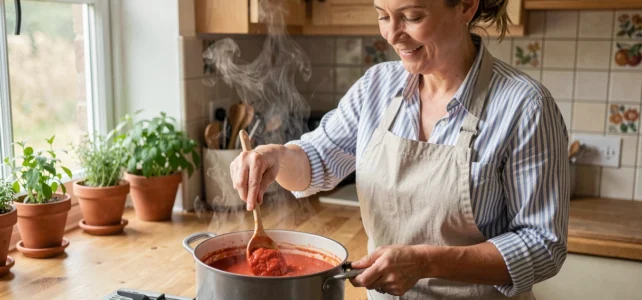
Homemade tomato sauce, prepared in quantity on Sunday and portioned for the week, serves as a base for pasta, homemade pizzas, and quiche fillings. Adding a celery stalk during reduction gives an aromatic depth that sugar cannot replace.

The emulsified vinaigrette (mustard, oil, cider vinegar, shallot) pairs well with both salads and warm vegetables. Preparing a jar for the week eliminates a daily micro-task that, when accumulated, weighs on culinary mental load.
Targeted batch cooking: preparing the bases without spending all Sunday
Complete batch cooking (preparing five full meals in advance) discourages many families due to its scale. Preparing only the bases and sauces cuts cooking time during the week in half without requiring a whole Sunday in the kitchen.
Specifically, a forty-five minute session is enough to:
- Cook a large quantity of rice or pasta, portioned into three batches in the refrigerator
- Roast two trays of assorted vegetables (squash, broccoli, carrots) usable as sides, tart fillings, or salads
- Prepare a tomato sauce and a béchamel, stored in jars
- Slice and marinate a protein (lemon-herb chicken, soy sauce tofu) ready to cook in a few minutes in the evening
This method works because it preserves the freedom of choice at mealtime. On Monday evening, you assemble a gratin with the roasted vegetables, béchamel, and grated cheese. On Tuesday, the same vegetables become a quiche filling with the eggs and cream from the refrigerator.
Seasonal adaptation happens naturally: in summer, roasted vegetables give way to prepared raw vegetables (cucumber, tomatoes, bell peppers) and hot dishes shorten in favor of complete composed salads. The principle remains the same, only the ingredients rotate.
The real gain from this approach is not measured solely in saved minutes. It’s the removal of the daily question “what are we eating tonight” that most lightens the mental load for families, because the answer is already in the refrigerator.