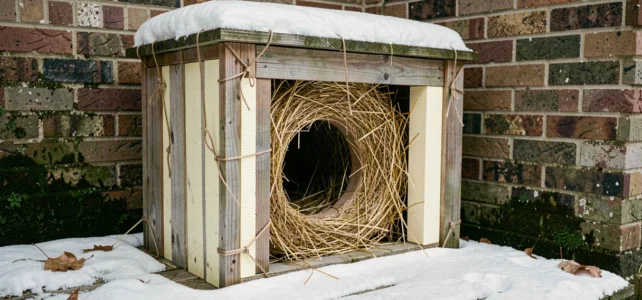
A shelter for a stray cat placed directly on the ground, with its back to the pouring rain, filled with straw installed in October and never changed since: this is the most common and least protective scenario. The insulation of an outdoor cat house is not just about piling layers of material. What kills colony cats in winter is primarily humidity and wind, long before the dry cold.
Humidity and drafts in a cat shelter: the real enemies
It is often thought that a well-padded shelter is enough to protect a stray cat. In reality, a perfectly insulated refuge that is exposed to water infiltration or drafts remains dangerous. A dry and windproof shelter protects better than an over-insulated but damp one.
Water seeps in from below (capillary rise from the ground), through the entrance (rain driven by the wind), and through poorly sealed joints of the lid. The wind, on the other hand, passes through any opening and cancels out the effect of the body heat that the cat accumulates inside.
Before choosing an insulator, we thus address two problems in this order: elevate the structure to cut contact with the wet ground, then orient the entrance away from the prevailing wind, ideally facing a wall or a hedge that breaks the gusts. Those looking to insulate a cat shelter with Cani Essence will find this logic detailed step by step.
The elevation can be done with treated wooden feet, concrete blocks, or even two stacked pallets. A height of a few centimeters is enough to prevent stagnant water from reaching the floor of the shelter.

Polystyrene, straw, or blanket: which insulator to choose for an outdoor shelter
The choice of insulation material depends on a simple constraint: the insulator must not retain water. This is the criterion that eliminates most options that appear comfortable.
Straw: the best insulator as long as it is renewed
Straw (not hay) remains the most recommended material by animal protection associations for outdoor shelters. Its hollow stalks trap air and create an effective thermal barrier. The cat burrows into it and retains its body heat.
The trap is to install it at the beginning of the season and not touch it again. Straw compresses, absorbs moisture, and loses its insulating power within a few weeks. Reports from shelters published between 2024 and 2026 indicate that non-renewed straw promotes hypothermia and respiratory infections. It is advisable to replace it every two to three weeks during freezing periods.
Extruded polystyrene: structural insulation
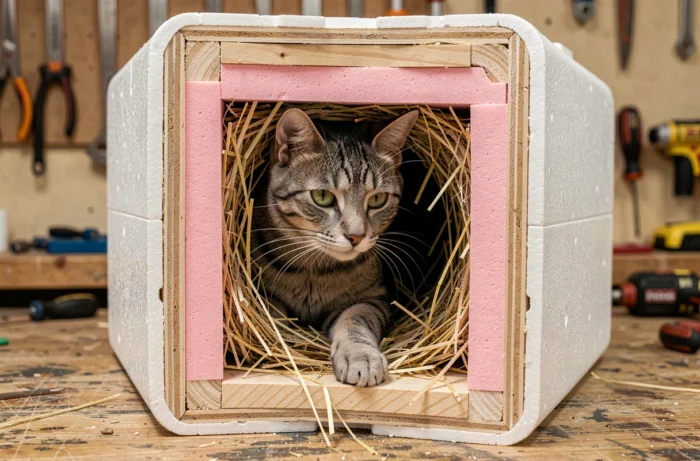
For the walls and floor, sheets of extruded polystyrene cut to the internal dimensions of the box provide durable insulation. They are fixed between two layers (the outer container and an inner covering) so that the cat does not scratch them or ingest pieces.
A plastic box like a storage bin, lined with polystyrene on all four sides and the ceiling, constitutes a secure and easy-to-clean structure.
What to avoid
- Fabric blankets and towels: they absorb moisture, freeze, and become a cooling factor instead of warming the animal
- Hay: often confused with straw, it retains water and molds quickly
- Rugs or carpets: the same absorption problem, with the added issue of very slow drying in winter conditions
Dimensions and entrance of the shelter: what many oversize
An overly large shelter is a poorly heated shelter. The cat warms the interior air with its own body heat. The smaller the volume, the faster the temperature rises and is maintained.
The interior space should allow the cat to turn around, not to roam. We aim for just enough volume for one or two animals. If multiple cats frequent the same area, it is better to place two small shelters than one large one.
The entrance deserves special attention. It should be large enough to allow an adult cat to pass through (an opening about the width of a cat’s head is sufficient), but no more. The wider the opening, the more wind and rain enter.
- Cut the entrance on one side rather than in the center of the front face, so the cat can snuggle into a blind spot sheltered from the wind
- Add a flexible flap (thick tarp or cut plastic) that allows the animal to pass while blocking drafts
- Provide a second exit if predators (dogs, foxes) frequent the area, so the cat is not trapped
Location and winter maintenance of the stray cat shelter
A well-built shelter placed in the wrong location will not be useful. We look for a spot sheltered from the prevailing wind, protected by an existing structure (wall, dense hedge, roof overhang). The entrance facing a nearby wall forces the air to go around the shelter instead of rushing in.
The ground under the shelter must drain properly. We avoid hollows where water stagnates and areas of clay soil that remain soaked. A gravel bed under the elevation supports improves drainage effortlessly.
Regarding maintenance, we check the shelter at least once a week during cold periods: condition of the straw, absence of infiltration, general cleanliness. A dirty or damp shelter will be deserted by cats, who will prefer to sleep under a car, with the risks that entails.
Feedback varies on the issue of solar or battery-powered heating mats. Their effectiveness depends on the installation and local climate. In regions where frost is moderate, well-executed passive insulation (polystyrene, renewed straw, elevation, windbreak) largely meets the needs without an external energy source.
A shelter for a stray cat requires neither a significant budget nor carpentry skills. A plastic box, polystyrene, fresh straw, and a thoughtful location are enough to make the difference between a survivable winter and a night too many.