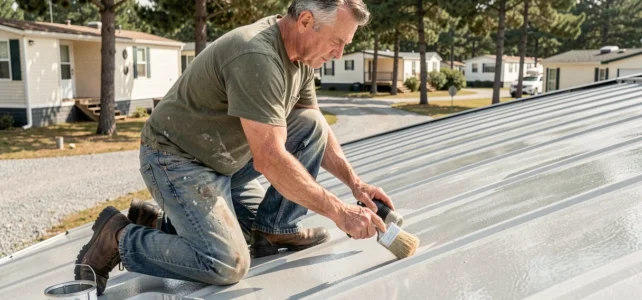
The roof of a mobile home is made of galvanized steel or aluminum panels, sometimes covered with a polyester coating. This composition requires a different painting protocol than that of a traditional house: adhesion on smooth metal is low, and thermal expansions related to the thin thickness of the roof cause micro-cracks if the product used is not sufficiently flexible.
Regulatory constraint before painting a mobile home roof
Changing the visible color of a roof, even on a mobile home installed in a campsite or residential leisure park, constitutes a modification of the external appearance under the urban planning code. A prior declaration of work at the town hall is then necessary, with a processing time of about one month.
The Local Urban Plan (PLU) of the municipality sets the authorized shades. Painting a roof reflective white, for example, may be refused in certain heritage or coastal areas. Before purchasing any paint, check the PLU and consult the land manager if the mobile home is located in a private park: the internal regulations may impose specific colors.
When wishing to paint the roof of a mobile home, this administrative step is often overlooked, even though it determines the legality of the project.
Preparation of the metal substrate: the step that determines durability
On a mobile home roof, the paint does not adhere due to the porosity of the substrate (there is almost none) but due to the mechanical and chemical grip created during preparation. Skipping or rushing this phase reduces the lifespan of the coating to just a few seasons.
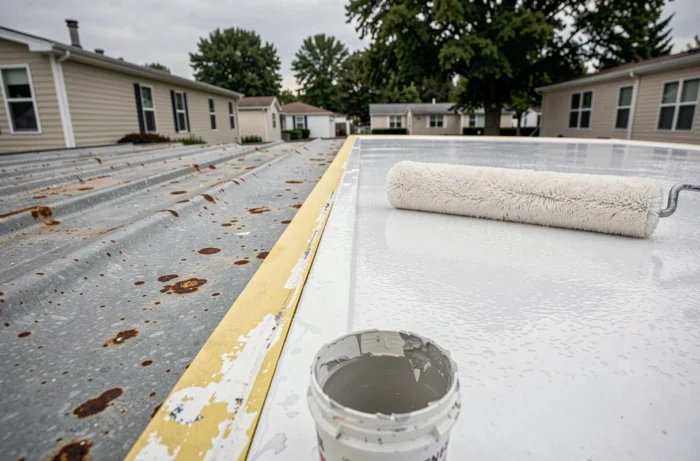
Cleaning and degreasing
Start by removing moss, lichens, and dirt using a low-pressure cleaner (no more than 80-100 bars to avoid deforming the thin metal). An alkaline degreaser applied with a sprayer and then rinsed with clean water removes greasy residues that prevent adhesion.
Light sanding and treatment of rust spots
In areas where the galvanization is still intact, light sanding with fine grit (P180-P240) is sufficient to create a micro-roughness. Visible rust spots require more thorough treatment:
- Scrape the rust with a painter’s knife or wire brush until reaching healthy metal
- Apply a rust converter that transforms iron oxide into a stable and paintable layer
- Allow to dry for the time indicated on the technical data sheet of the converter before any painting
Each untreated rust spot becomes a detachment point that spreads under the paint film by capillarity. On a roof exposed continuously to the elements, corrosion progresses quickly.
Choosing paint for mobile home roofs
The market offers three main families of products suitable for metal roofs. The choice depends on the budget, local climate, and desired outcome (simple protection, thermal reflection, or enhanced waterproofing).
Special metal acrylic paint
Formulated in a water-based phase, it dries quickly, emits little odor, and can be cleaned with water. Its flexibility makes it compatible with the expansions of a mobile home panel. However, its dry film thickness remains modest, which makes it more suitable for roofs in generally good condition, without waterproofing issues.
Polyurethane paint
More resistant to abrasion and UV rays, polyurethane paint offers a thicker film and better impermeability. It is suitable for roofs exposed to intense sunlight or sea spray. The application requires more precautions (ventilation, longer drying time between coats).
Reflective paint (cool roof)
These high reflectance products reflect a significant portion of solar radiation and reduce the interior temperature of the mobile home in summer. To assess their actual performance, request the complete technical data sheet with the SRI index (Solar Reflectance Index): the higher it is, the more the product reflects heat. A properly applied reflective paint retains its properties for ten to fifteen years.
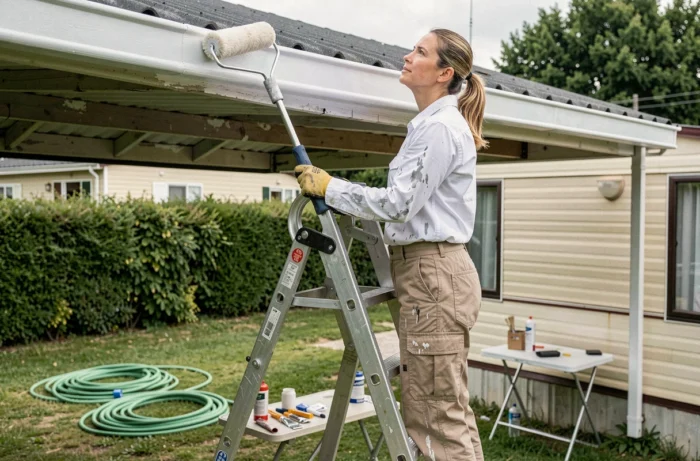
Application: method and weather conditions for a lasting result
The success of the project depends as much on the technique as on the product. Two common mistakes negate the effect of good paint: applying in humid weather and not respecting the recommended thicknesses.
Adhesion primer
On galvanized metal or aluminum, a specific adhesion primer for non-ferrous metals is necessary. It creates a chemical bridge between the smooth substrate and the finishing layer. Without this primer, the paint film eventually peels off in large sheets, often by the first winter.
Number of coats and thickness
Two finishing coats are the minimum for lasting protection. Each coat must respect the wet thickness indicated on the container (usually measurable with a thickness gauge). Applying too thinly to save costs reduces the lifespan by half.
Ideal weather window
The application conditions affect adhesion and drying:
- Ambient temperature between 10 °C and 30 °C, ideally around 20 °C
- Humidity below 80% to avoid film whitening
- No rain forecasted within 24 hours after application
- Metal not hot to the touch (avoid painting in direct sunlight in the afternoon during summer)
Working early in the morning or late in the day, when the metal has warmed up without being overheated, yields the best results. Too rapid drying under extreme heat traps solvents in the film and causes blisters a few weeks later.
Painting a mobile home roof does not require complex tools, but it tolerates no shortcuts on substrate preparation or adherence to application conditions. The adhesion primer remains the most often forgotten step, yet it makes the difference between a renovation that lasts a decade and a coating that peels off by the second summer.