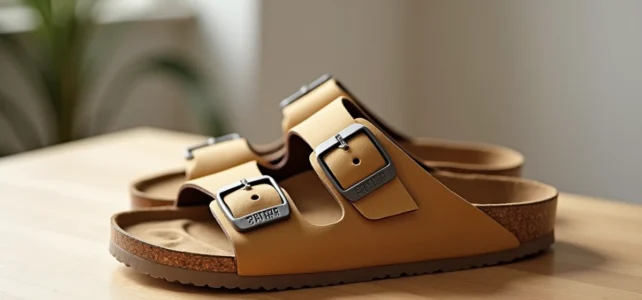
The insole of an authentic Birkenstock is not just a molded block of cork. It is a patented multi-layer assembly, and it is precisely in understanding this assembly that the distinction between an original pair and a counterfeit lies. Here, we detail the most reliable checkpoints, those that withstand increasingly sophisticated copies.
Birkenstock Footbed: Anatomy of a Sole That Is Not Easily Copied
The anatomical Birkenstock footbed features a pronounced arch, a deep heel cup, and an elevated metatarsal support. These three contours must be symmetrical between the left and right foot, with a gradual transition, never abrupt.
On a counterfeit, the arch is often flattened or misaligned by several millimeters from the correct anatomical position. The cork used in fake models is distinguishable by its texture: irregular grain size, overly uniform color, and the absence of that slight elasticity under thumb pressure found in the natural cork mixed with latex in the originals.
One point we regularly observe: the internal marking on the leather of the insole must remain consistent between the two shoes. Size, model, country of manufacture—these inscriptions must be identical and aligned in the same way. On counterfeits, it happens that the markings differ from one foot to the other, revealing a lack of quality control.
To delve deeper into this topic, it is useful to differentiate a Birkenstock counterfeit on Caro Bleue Violette before any online purchase.
Birkenstock Logo and Markings: What Recent Copies Poorly Imitate
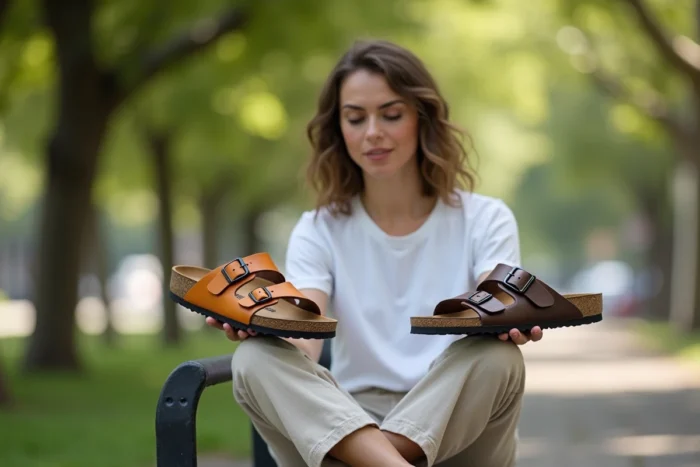
The logo stamped on the metal buckle and that printed on the insole adhere to precise standards. On the Arizona or Boston models, the buckle features a raised logo with a sharp outline, without any smudging.
Recent counterfeits reproduce the general shape of the logo but fail on two details:
- The thickness of the lettering on the buckle, often too thin or too thick compared to the original, with less precise relief to the touch
- The color of the metal of the buckle, which tends toward an overly shiny silver or a dull gold, whereas Birkenstock uses matte finishes specific to each color
- The positioning of the logo on the insole, which must be centered and printed with wear-resistant ink, not simply screen-printed on the surface
The logo alone is no longer sufficient to authenticate a pair. We recommend systematically cross-checking this verification with an examination of the footbed and the outsole.
Outsole and Visible Cork: Manufacturing Clues on Boston and Arizona
The EVA outsole of Birkenstocks features a regular herringbone pattern, with a consistent depth of sculpting. On a counterfeit, this pattern is often less deep or slightly asymmetrical.
The visible cork edge between the insole and the outsole is a reliable indicator. On an authentic model, the cork is covered with a slightly shiny transparent sealant, applied evenly. Fakes often have raw, porous cork, or conversely, a thick varnish that cracks quickly.
On the Boston model in particular, the collector community has identified a recurring detail in counterfeits: the shape of the lateral adjustment button. On the original, this button has a slightly rounded profile with smooth edges. Copies use a flat button or one with sharp edges, made with a lower quality alloy.
Leather and Materials: The Touch Does Not Lie
Birkenstock leather (nubuck, suede, or smooth leather depending on the model) has a characteristic softness from the first handling. Counterfeit leather is generally stiffer, with a pronounced chemical smell. The suede of authentic Boston models features a fine and even grain, while copies often display a coarse grain or an almost plasticized surface.
Price and Sales Channel: The Most Effective Filter Against Fake Birkenstocks
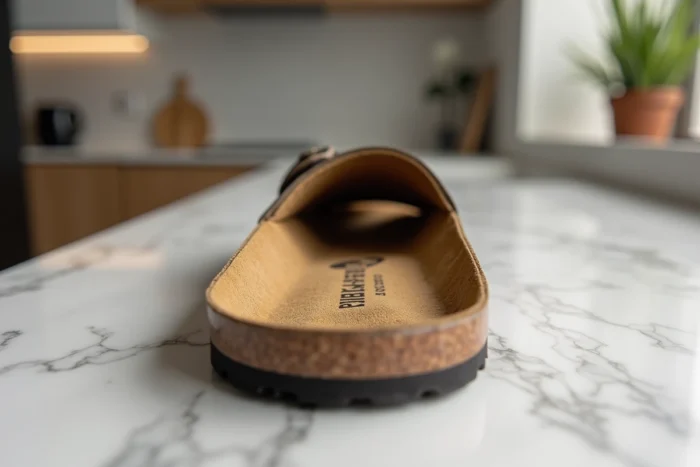
Birkenstock has explicitly taken a stance on distribution channels. The brand indicates that offers with significant discounts on third-party sites are an almost systematic indicator of counterfeiting. A pair sold significantly below the catalog price, shipped from a third country, accumulates warning signals.
Birkenstock’s anti-counterfeiting policy goes beyond simple visual advice: the brand highlights the legal risks associated with purchasing on unauthorized marketplaces, and specifies that certain transactions may be considered illegal depending on the jurisdiction.
- Buying only from the official Birkenstock website or authorized retailers eliminates most of the risk
- A price “too good to be true” is the first filter, even before examining the pair
- Peer-to-peer resale platforms require cross-checking multiple physical indicators, never just one
Cross-Check Indicators Rather Than Isolate One
The most advanced counterfeits correctly reproduce one or two elements (the logo, the general shape). None reproduce everything: anatomical footbed, quality of the cork, consistent internal markings, buckle finish, edge sealant. It is the convergence of several checks that authenticates a Birkenstock, not an isolated detail.
Forgers are progressing, but the complexity of the multi-layer assembly patented by Birkenstock remains their main limitation. A buyer who takes thirty seconds to flip the pair over, feel the cork, and compare the markings between the left and right foot already has a more reliable verification protocol than most online visual guides.