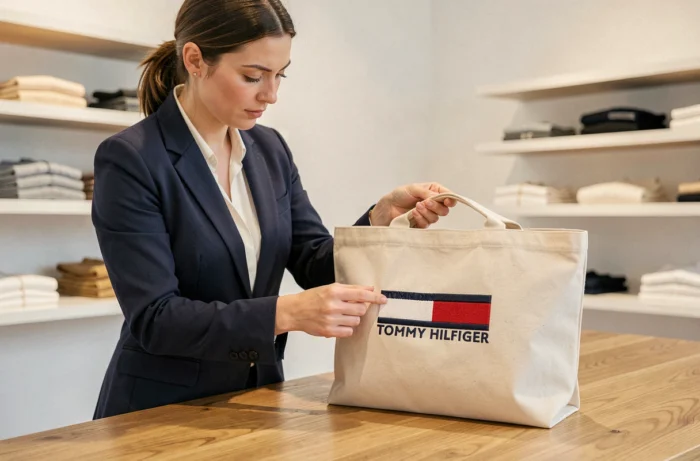
The counterfeiting of Tommy Hilfiger bags has become so professional that it can deceive seasoned buyers. Recent copies reproduce logos, serial numbers, and packaging with a precision that makes a quick visual inspection insufficient. To distinguish an authentic bag from a fake, one must go beyond appearances and cross-reference several material, structural, and commercial clues.
Limitations of Tommy Hilfiger product codes and labels
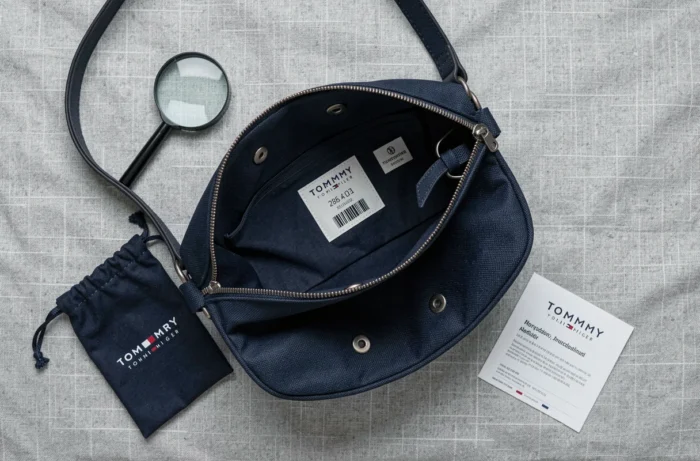
A common reflex is to check the serial number or product code on the inner label. This step is necessary, but it is not enough to prove the authenticity of a bag. Manufacturing markings can be copied with sufficient fidelity to appear credible.
A manifestly inconsistent code (missing characters, a different font than that used by Tommy Hilfiger, unusual formatting) can rule out a crude counterfeit. However, a plausible code does not guarantee anything on its own. It must be cross-referenced with the construction of the bag, the materials used, and all the finishes.
The same logic applies to accompanying accessories. Box, protective cover, authenticity card, or invoice can be counterfeited or resold separately. A well-crafted packaging does not constitute standalone proof. It only serves to verify the overall consistency of the purchase file. When examining the distinctive signs of Tommy Hilfiger bags, this cross-referencing approach makes perfect sense.
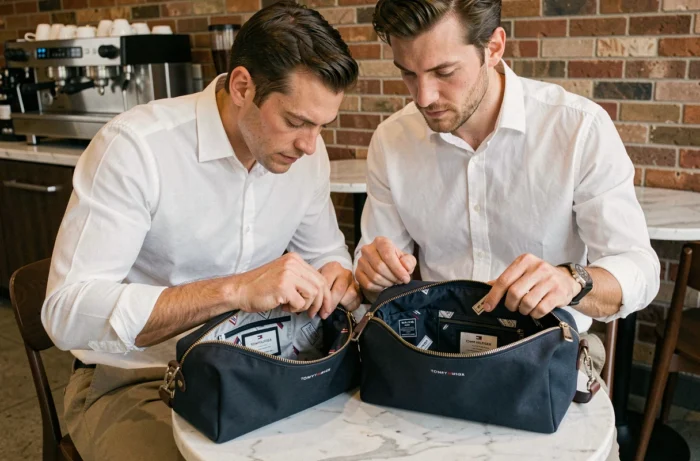
Stitching, leather, and finishes: the tactile examination of a Tommy Hilfiger bag
The most reliable clues are found in the physical construction of the bag. The quality of the stitching serves as a first discriminating filter.
Stitching points and consistency
On an authentic Tommy Hilfiger bag, the stitching is consistent, with evenly sized stitches and no threads sticking out. The topstitching follows straight lines or sharp curves. A counterfeit often shows visible irregularities to the naked eye: variable spacing between stitches, short or frayed threads, stitching that does not align exactly with the edges.
The finishes of the edges of leather or faux leather often betray copies. On an original model, the edges are smoothed and uniformly dyed. On an imitation, the edge may be rough, whitish, or show signs of glue.
Materials and hardware
The leather used by Tommy Hilfiger has a soft texture and a consistent grain. The canvas or synthetic bags from the brand maintain a certain structure without excessive rigidity. A counterfeit is often distinguished by a plastic feel, a pronounced chemical smell, or overly thin fabric.
- Zippers should slide smoothly, with a slider featuring a clear engraving (not just printed).
- The snap buttons, rivets, and metal buckles of an authentic bag have a noticeable weight and a uniform finish, without burrs or discoloration.
- The inner lining is neatly sewn, without stray folds or misalignment with the outer seams.
The embroidered Tommy Hilfiger flag: a detail often poorly reproduced
The flag logo (the blue, white, and red rectangle) is one of the most copied elements, but also one of the most difficult to reproduce perfectly. On an original bag, the embroidery is dense, with saturated colors and sharp transitions between the stripes.
Counterfeits often feature a flag with slightly off colors, a blue that leans towards purple, a red that is too orange, or a grayish white. The spacing between the letters of the name “TOMMY HILFIGER” under the flag also varies: too tight, too spaced, or with a subtly different font.
Looking at the flag in natural light allows one to spot differences in shade. On some copies, the thread used for the embroidery has a shiny appearance that does not match the matte finish of the threads used by the brand.
Seller behavior: a signal as reliable as the bag itself
The authenticity of a Tommy Hilfiger bag is not verified solely on the item. The seller’s behavior provides equally revealing clues, especially when purchasing online on resale platforms.
The refusal to provide detailed photographs is a major red flag. A legitimate seller agrees to photograph the inner label, the inscriptions on the metal, the stitching, the lining, and the edge finishes. Any reluctance to show these specific areas should raise suspicion.
Other elements deserve attention:
- A price significantly lower than the usual retail price at an official store or authorized leather goods shop, without a clear justification (sales, identified clearance).
- A seller offering several dozen bags from different brands at reduced prices, suggesting a supply of counterfeits.
- The absence of a return policy or warranty, or deliberately vague conditions.
- Generic photos identical to those on the official Tommy Hilfiger site rather than actual product shots.
Buying through an official Tommy Hilfiger store or an authorized reseller remains the safest way to avoid counterfeits. For the second-hand market, using an independent authentication service adds a layer of verification that neither photos nor codes can replace on their own.
The counterfeiting of Tommy Hilfiger leather goods is not limited to bags: wallets, belts, and leather accessories are also affected. The same verification reflexes (stitching, materials, hardware, seller traceability) apply to the entire collection.