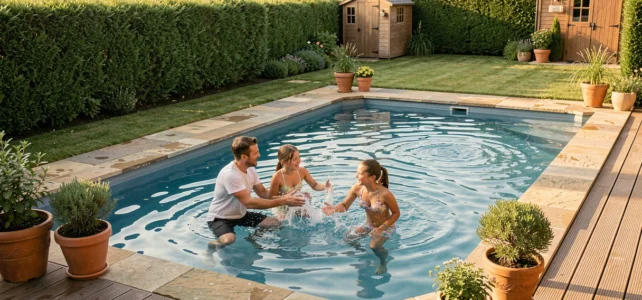
A pool that is too large consumes the garden, while a pool that is too small frustrates everyone from the first summer. The choice of dimensions for a family pool is based on very concrete constraints: the available space, the depth suitable for children, and the urban planning regulations that govern your project.
Depth of a family pool: what recent data shows
Before discussing length or width, depth deserves special attention. It determines whether your children can stand, whether adults can swim comfortably, and whether maintenance remains manageable.
The FPP 2025 Barometer (Federation of Pool and Spa Professionals), referenced by Ouest-Azur in July 2026, provides concrete insight: about 78% of family pools installed in France have a depth between 1.30 m and 1.50 m. The 2 m deep pools, common in the 1990s and 2000s, are clearly declining.
Why does this range dominate? Because at 1.40 m, an average-sized adult can stand everywhere. A teenager can swim without difficulty. And an 8-10 year old child can touch the bottom in the shallowest part if the pool has a gently sloping bottom.
A flat bottom at 1.35 m is suitable for families who want to play in the water together. A sloping bottom (from 1.10 m to 1.50 m) offers more versatility: a natural wading area on one side, a swimming area on the other. A variable depth remains the best compromise for mixed family use.
Before choosing the dimensions of a family pool, first ask yourself about the depth: it conditions the volume of water, the heating cost, and the level of safety for the youngest.
Pool surface and garden space: the real constraints
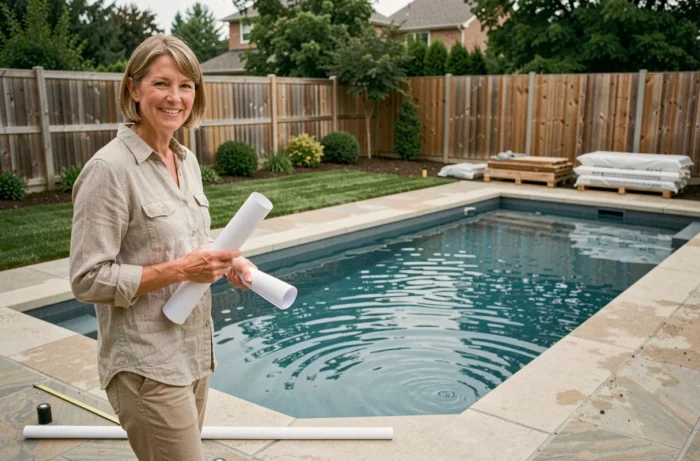
Do you have a plot of 300 m² or 800 m²? The answer will not be the same. Two formats dominate the French market for polyester shell pools: 8×4 m and 7×3.5 m. These dimensions have become standard because they fit the majority of suburban gardens.
What pool surface for what use
A pool of 7×3.5 m (approximately 24 m² of water surface) is sufficient for a family of four who wants to swim, play, and cool off. To actually swim, a minimum length of 8 m is required.
Beyond the water surface, consider the circulation space around the pool. Allow at least 1.50 m of clearance on each side for movement, placing sun loungers, and ensuring the safety of running children.
- Garden of less than 200 m²: a pool of 5×3 m to 6×3 m preserves enough green space. The mini-pool becomes relevant in this case.
- Garden of 300 to 500 m²: the 7×3.5 m or 8×4 m format fits without overwhelming the rest of the land.
- Garden of more than 600 m²: a pool of 9×4.5 m or a swimming lane (12 to 15 m long, 2.5 to 3 m wide) becomes feasible if competitive swimming is one of your priorities.
The distance from property boundaries
The Urban Planning Code generally requires a minimum setback of 3 m between the pool and the boundary of your property. This setback reduces the usable area, sometimes significantly on narrow plots. Check your local urban planning plan (PLU): some municipalities impose greater distances.
Urban planning procedures according to pool dimensions
The size of the pool has a direct administrative consequence, and many individuals discover this too late.
- Pool of less than 10 m² surface: no declaration is required in most cases, unless the PLU specifies specific restrictions.
- Pool between 10 m² and 100 m²: a prior declaration of work is mandatory at the town hall.
- Pool of more than 100 m²: a building permit is required, with the involvement of an architect if the total built area of the property exceeds certain thresholds.
In other words, an 8×4 m pool (32 m²) automatically triggers a prior declaration. Even a mini-pool of 4×3 m (12 m²) falls into this category. Only very small pools (3×2.5 m, for example) may escape this.
Pool covers add a layer of complexity. If the cover exceeds 1.80 m in height, it is also included in the calculation of declared surfaces. Anticipate this point from the sizing phase.
Pool shape and dimensions: a often underestimated link
The rectangular shape remains the most common for family pools. It maximizes the swimming surface relative to the footprint. A rectangle of 8×4 m offers 32 m² of nearly complete usable surface.
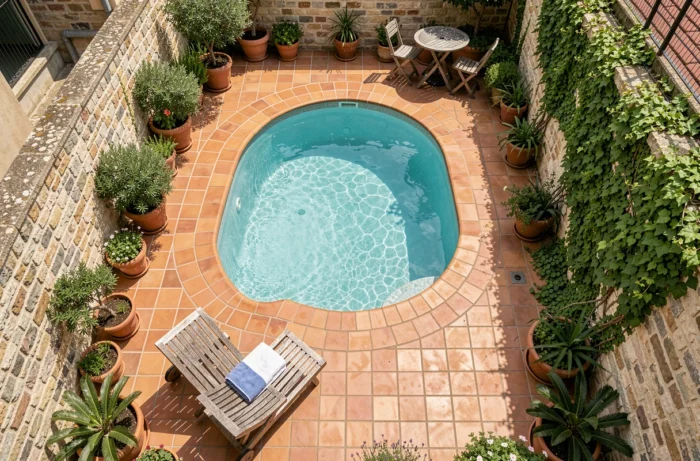
A bean-shaped or freeform pool, with an equivalent footprint, loses swimming surface due to curves. For the same footprint, a rectangular pool offers 15 to 20% more swimming surface than a freeform shape.
Are you torn between aesthetics and functionality? Rounded shapes integrate better into a landscaped garden with flower beds. Geometric shapes suit contemporary terraces and swimming lanes.
Water volume and maintenance: the direct consequence of chosen dimensions
The larger the pool, the greater the volume of water, and with it the maintenance time, the consumption of treatment products, and the heating cost. An 8×4 m pool at an average depth of 1.40 m contains a significantly larger volume of water than a 6×3 m pool at 1.20 m.
The filtration system must be sized according to the total volume. An undersized filter leads to cloudy water and overconsumption of chlorine or salt. The volume of water conditions the annual maintenance budget as much as the construction cost.
Before finalizing your dimensions, have a professional estimate the water volume. This figure determines the pump power, the filter size, and the heating cost if you opt for heating.
The ideal dimensions of a family pool are not just a magic formula. They result from a trade-off between the depth suitable for your children, the surface that your garden can actually accommodate (including setbacks), and the maintenance budget you are willing to bear each year. The 7×3.5 m to 8×4 m format with a depth between 1.30 m and 1.50 m meets the vast majority of family needs, and market data in France confirms this.