
When you type “Brad Pitt vegan” into a search engine, you come across contradictory claims. Some articles present him as a long-time vegan activist, while others strongly qualify this. The topic deserves a closer look to untangle what is based on verifiable statements and what is part of the media storytelling surrounding the actor’s diet.
Vegan Claims and Labeling: What the 2026 European Directive Changes
Before discussing Brad Pitt, a detour through regulation is necessary. The EU Directive 2024/825, applicable from September 27, 2026, tightens the rules on vague environmental claims made on packaging. It also concerns how the term “vegan” is presented when associated with visual codes of sustainability.
The Vegan Society announced in 2026 that it was redesigning its logo to comply with these new requirements. The organization is replacing the historic sunflower with a circle of checks, a change directly linked to European regulatory pressure on labels that could be interpreted as environmental promises.
This context is useful for understanding why celebrity statements about their vegan lifestyle are increasingly scrutinized. An actor who claims to be vegan in an interview does not bear legal responsibility, but brands that exploit this image in their communication must now prove their claims. One can explore in detail brad pitt and his vegan lifestyle to measure the gap between public image and documented practices.
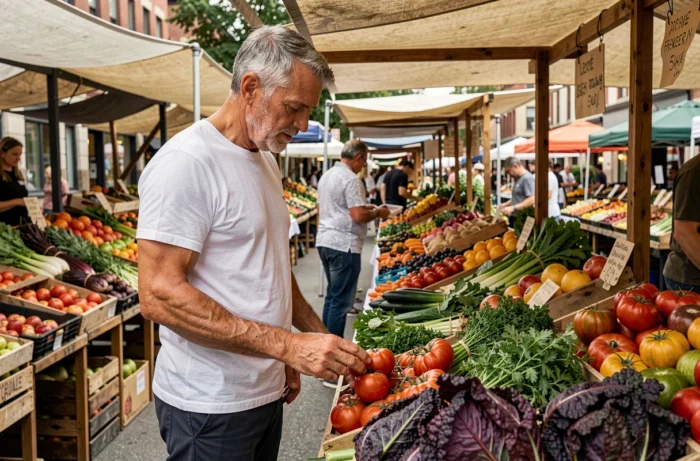
Brad Pitt Vegetarian or Vegan: What the Sources Really Say
The confusion between vegetarianism and veganism consistently appears in articles about the actor. Several media outlets classify him among the “long-time vegetarian stars,” alongside Pamela Anderson or Moby. The distinction between no longer eating meat and adopting a lifestyle without any products derived from animal exploitation (leather, wool, cosmetics tested on animals) is rarely made.
Veganism is not limited to the plate. It involves renouncing leather, fur, wool, and cosmetics tested on animals. In this regard, public information about Brad Pitt remains vague.
Motivations Expressed by Vegan Celebrities
By compiling statements from openly vegan stars, we identify three recurring categories of motivations:
- Sensitivity to animal rights, as expressed by Jessica Chastain: “It’s about trying to live a life where I don’t contribute to cruelty in the world.”
- Environmental reasons, notably championed by personalities like Lewis Hamilton, who emphasize the carbon footprint of livestock.
- Health or physical performance reasons, often cited by athletes or actors concerned about their condition.
Brad Pitt has never publicly detailed his motivations with the same degree of precision as these personalities. The lack of a detailed statement fuels the ambiguity between real commitment and constructed media image.
Vegan Wines and the Miraval Estate: A Rarely Explored Angle
It is often forgotten that Brad Pitt is a co-owner of the Miraval estate in Provence, a vineyard that produces some of the most publicized rosé wines in France. The question of vegan wine arises directly here.
A conventional wine uses animal-derived fining agents (casein from milk, egg albumin, gelatin, fish glue) to clarify the product. A vegan wine excludes these agents in favor of mineral or plant-based alternatives. Opinions vary on this point: some oenologists believe the taste difference is imperceptible, while others find it significant with certain grape varieties.
To date, Miraval wines are not marketed with a vegan label. For someone presented as a committed vegan, this is an angle that the tabloid press rarely highlights. The estate is part of a certified organic approach, but organic and vegan are two distinct things in the wine world.

The Vegan Wine Market in France
The vegan wine market is growing in France, driven by a rising demand for transparency in winemaking methods. Consumers who adopt a vegan diet often discover with surprise that most wines are not vegan by default.
The tightening of European regulations on environmental claims also affects the wine sector. A vineyard wishing to label its bottles as “vegan” must now document its entire production chain, from fining agents to label adhesives.
Myth or Reality: The Limits of Media Veganism
The case of Brad Pitt illustrates a broader phenomenon. A celebrity associated with veganism in the media generates a ripple effect on the general public. However, this association often relies on isolated statements that are repeated and amplified without verification.
Several concrete elements allow us to distinguish a real vegan commitment from a constructed image:
- Consistency between dietary discourse and clothing choices (leather, wool, silk)
- Involvement in verifiable associations or campaigns, such as those of PETA
- Duration over time, as many personalities abandon the diet after a few years (Anne Hathaway has publicly recounted her return to fish consumption)
- Investment and production choices, particularly in areas like food or wine
Brad Pitt remains in a documentary gray area. We know he has reduced his meat consumption for many years. We know he is sensitive to animal rights. However, we do not have sufficient evidence to assert that he leads a fully vegan lifestyle in the strictest sense of the term.
The next time an article headlines “Brad Pitt, vegan star,” the question to ask is simple: vegetarian or vegan, and on what specific criteria does the claim rest? The answer, in most cases, is more of an editorial shortcut than a verified fact.