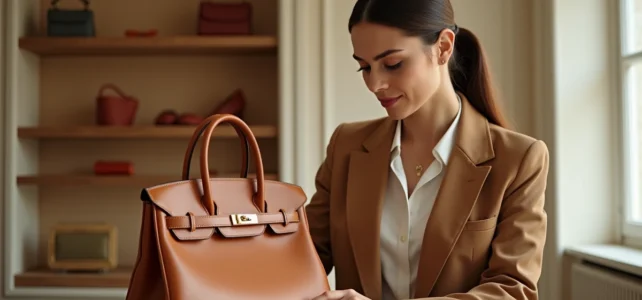
In the secondary Hermès market, price differences between two bags of the same model can vary from simple to quadruple depending on the size, leather, and color. Understanding these variables before buying helps avoid overpricing and targets pieces whose value holds up best over time.
Hermès Sizes and Resale Premium: What the Differences Reveal
The hierarchy of desirability in the second-hand Hermès market has significantly evolved in recent years. Larger sizes no longer systematically command the highest prices. In 2026, the Mini Kelly 20 and Kelly Pochette can exceed three to four and a half times their retail price, depending on the condition, leather, and color.
| Model / Size | Secondary Market Premium Trend | Usage Profile |
|---|---|---|
| Birkin 25 | High, stable premium | Versatile, handheld or arm carry |
| Birkin 30 | Moderate, relatively declining premium | Classic, bulkier |
| Kelly 25 / 28 | High, increasing premium | Structured silhouette, shoulder strap possible |
| Mini Kelly 20 | Very high premium (up to 4.5x retail price) | Compact size, strong current demand |
| Kelly Pochette | Very high premium | Evening clutch, collector’s item |
| Constance 18 / 24 | Sustained premium | Shoulder strap, crossbody format |
This table reflects a clear shift. The reflex of “the larger the bag, the more expensive it is” no longer holds. Compact sizes, more suited to current silhouettes and daily uses, concentrate demand and therefore the premium. For those looking to find a second-hand Hermès bag with good value retention potential, betting on a Kelly 25 or a Mini Kelly 20 proves more relevant than a Birkin 35.
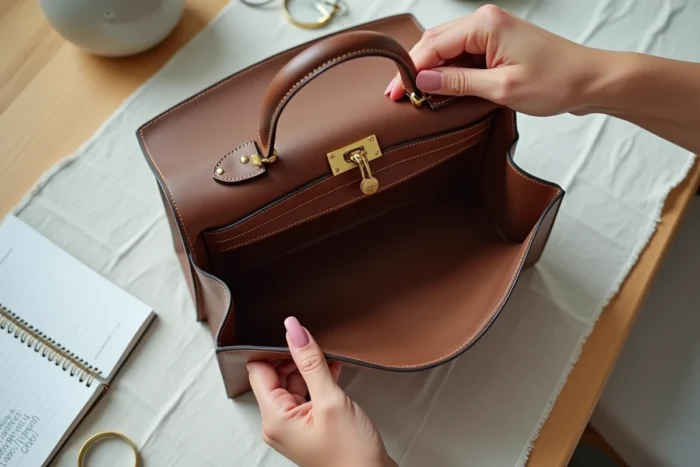
Authentication of a Second-Hand Hermès Bag: Technical Checkpoints
The counterfeiting of Hermès bags has reached a level of sophistication that makes superficial visual examination insufficient. For a reliable second-hand purchase, physical authentication by an expert remains the only solid guarantee.
Leather and Stitching: What a Fake Cannot Reproduce
Hermès leathers (Togo, Clemence, Epsom, Box, Swift) each have a specific grain, flexibility, and feel. Togo leather has an irregular and natural grain, whereas a fake tends to have a texture that is too uniform. The patina of Box leather, for example, evolves characteristically over time.
Hermès saddle stitches are hand-sewn with waxed linen thread and two needles. The saddle stitch creates a slight zigzag angle. On a fake, the thread is often synthetic, and the stitches are perfectly straight.
Markings and Hardware
- The hot stamp “Hermès-Paris” on the strap or under the flap must be clear, centered, and slightly embossed into the leather, with no smudging or gilding that overflows
- The artisan’s logo (year letter and workshop code) is located under the closure tab. Its position and typography vary according to the manufacturing period, which serves as a reliable dating marker
- The hardware (turn lock, padlock, bell) is gold or palladium plated with a uniform finish. An irregular plating or visible screw indicates a problem
Using a platform with physical authentication (and not just photo-based) reduces the risk on high-value pieces. Some specialized retailers employ experts trained in Hermès specifics, who handle the bag, check the stitching with a thread count, and test the hardware.
Hermès Leathers and Second-Hand Value: The Combinations That Matter
The choice of leather directly influences the value of a vintage Hermès bag. Not all leathers age the same way, and not all resell at the same level.
The Togo leather remains the benchmark in the secondary market. Scratch-resistant and not sensitive to moisture, it maintains its structure over time. It is the most sought-after leather for Birkin and Kelly bags, and it has the highest liquidity at resale.
Clemence leather, which is softer, deforms more with use. Its secondary value is slightly lower than that of Togo, for equivalent model and color. In contrast, Box leather (smooth, shiny) appeals to vintage enthusiasts for its patina but requires careful maintenance: it is sensitive to scratches and does not tolerate shocks well.
Epsom leather, grainy and rigid, holds its shape well but has a drier feel. It is common on Kelly Sellier and Constance bags. Its value remains stable without reaching Togo levels on Birkin bags.
Neutral colors (black, taupe, gold) guarantee the best liquidity at resale. Bright or seasonal colors (Rose Sakura, Bleu Frida, Vert Criquet) create strong temporary premiums among collectors, but their market is narrower.
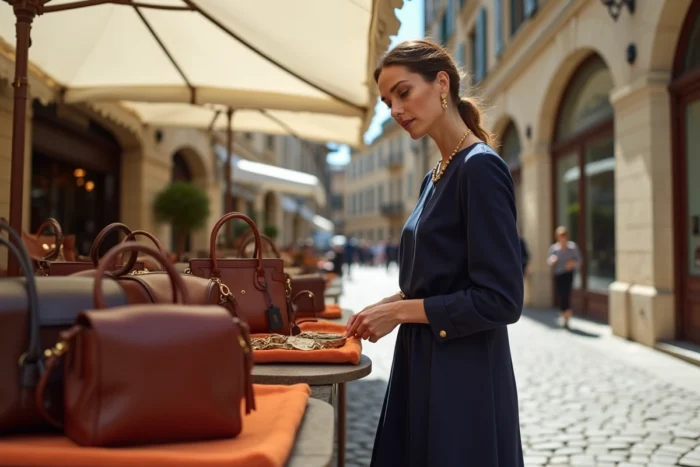
Where to Buy a Second-Hand Hermès Bag: Selection Criteria for the Channel
Three types of channels share the second-hand Hermès market. Each presents a different risk profile and level of service.
- Specialized physical boutiques (luxury consignment shops, dedicated retailers) allow you to see and touch the bag before purchase. Authentication is done on-site, and legal recourse in case of disputes is more direct
- Online platforms with integrated authentication offer a wider catalog and sometimes lower prices, but the expertise process varies by provider. Checking whether the authentication is physical or only photo-based makes all the difference
- Auction houses (Drouot, Christie’s, Artcurial) provide access to rare or vintage pieces. Buyer fees are added to the auction price and can represent a significant portion of the total cost
The chosen channel depends on the budget, the model sought, and the risk tolerance. For a first second-hand Hermès purchase, a channel with physical expertise and a return policy limits unpleasant surprises.
The secondary Hermès market rewards patience and precision. A well-chosen bag (sought-after size, durable leather, liquid color, rigorous authentication) retains its value over time, making it one of the few fashion items where buying second-hand sometimes surpasses new in economic relevance.