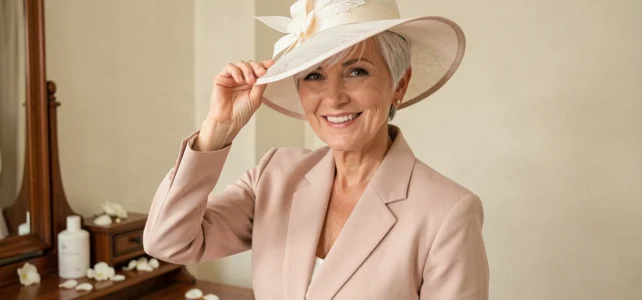
A wedding hat worn with short hair is based on a simple principle: the less hair that is visible, the more the headpiece structures the silhouette. A short cut exposes the neck and jawline, altering the visual balance between the face and the accessory. After 50, this configuration offers a clear frame where the hat serves to frame the face rather than merely being a decoration placed on a mass of hair.
Face Shape and Hat Style: The Technical Criterion to Address First
The choice of a ceremonial hat begins with the geometry of the face, not with the color or style of the dress. A round face benefits from being elongated by a tall model (a fascinator mounted on a small cone, for example), while an elongated face better supports wide brims that broaden the horizontal line.
With short hair, this logic becomes even more important. Long hair creates lateral volume that naturally softens the proportions of the hat. Without this volume, the shape of the hat interacts directly with the contours of the face. A model that is too voluminous on a slender face creates an imbalance; a model that is too flat on a round face accentuates the roundness.
Asymmetrical shapes work particularly well with short cuts. They break the symmetry of the exposed face and draw the eye to one side, adding movement to the whole. Choosing a wedding hat for short hair after 50 first involves identifying this proportion between the volume of the model and the shape of the face.
Fascinator, Veil or Wide Brim: What Hat Style for Short Hair
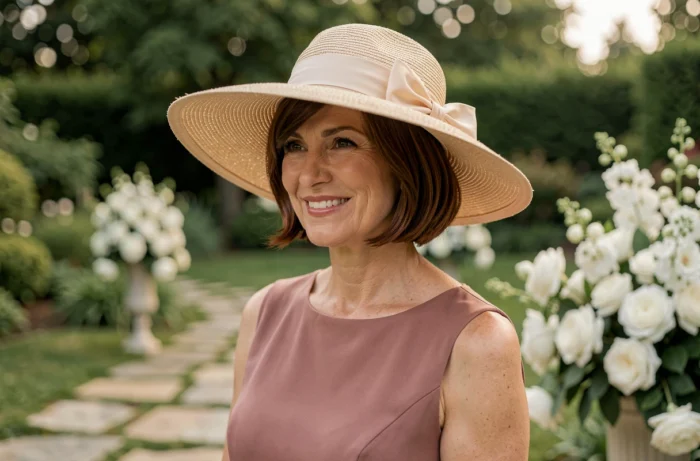
Large hats with wide brims are not excluded, but they require an outfit that complements them (bare shoulders, structured dress). With short hair, fascinators and veils offer a better balance because their small size does not create a disproportionate effect above a close-cropped cut or a short bob.
The fascinator is fixed to the side of the head, often secured by a comb or headband. It leaves most of the cut visible, avoiding the dreaded “helmet” effect that many women with short hair fear. The veil adds a textured dimension in front of the face without hiding the hairstyle.
The wide-brimmed hat remains an option for outdoor ceremonies, provided one chooses a medium brim rather than a very wide one. With short hair, a hat with too flared a brim overwhelms the silhouette from above. A moderately wide brim, slightly tilted forward, frames the face without engulfing it.
Materials According to the Season of the Wedding
The material of the hat directly depends on the time of year. Straw and sisal are suitable for summer weddings, with a light appearance that lifts the outfit. For autumn or winter, felt and wool provide a denser texture that matches the thick fabrics of seasonal dresses and suits.
This practical criterion is often overlooked in favor of aesthetics, but a felt hat under a July sun quickly becomes uncomfortable, and fine straw at a wedding in November seems out of place.
Securing and Keeping the Hat on Short Hair: Practical Solutions
Stability is the main technical challenge. Long hair allows a hat to be anchored with pins inserted into the hair mass. With a short cut, this option disappears. Several systems compensate for this lack of grip:
- The integrated headband in the hat ensures stable support without requiring long hair. Most ceremonial fascinators come equipped with this, and some milliners will add it upon request to models that do not have it.
- The fine-toothed comb, sewn inside the hat, grips onto short strands as long as the cut exceeds a few centimeters. It works poorly on very close-cropped styles.
- The discreet elastic, passed under the back bun or behind the ears, secures the hat during the day’s movements (hugs, dancing, outdoor wind).
Testing the stability while standing and moving before the big day helps avoid constant adjustments during the ceremony. A hat that slips every ten minutes loses all its effect.
Suitable Hair Products
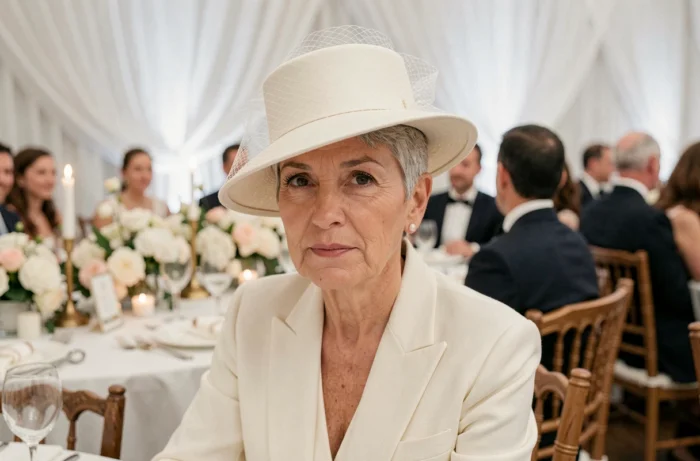
Too rigid hairsprays and gels create a smooth surface on which the hat slips. Light texturizers or flexible-hold sprays give some grip to the hair, improving the hat’s hold. This hair preparation, often forgotten, makes the difference between a stable hat and one that needs constant repositioning.
Coordinating the Hat with the Wedding Outfit After 50
The hat should not be chosen last. It is part of the overall composition just like the dress, shoes, and jewelry. With short hair, the hat visually occupies the space that long hair would fill in framing the face. It must therefore match in color and texture with the rest of the outfit.
A solid tone that matches the dress (or slightly lighter) creates a clean line. A strong contrast, on the other hand, draws the eye to the upper body, which can be desirable to highlight the face and neckline.
Ear jewelry also takes up more visual space with short hair. Dangling earrings paired with a discreet fascinator create a balanced ensemble. Conversely, a voluminous hat accompanied by large jewelry overloads the facial area.
- Fluid and solid dress: structured fascinator or veil that adds a contrast of texture.
- Pantsuit: medium-brimmed hat or small tilted hat, for a pronounced vertical line.
- Patterned dress: hat in a neutral tone drawn from the colors of the fabric, without additional decoration.
The final point to check is coherence with the wedding dress code. An outdoor country ceremony calls for natural materials and soft shapes. A reception in a historic venue or indoors allows for more elaborate models, adorned with feathers or tulles. The venue and time of the wedding influence the size and formality of the hat as much as the shape of the face.