Converting grams to cups, milliliters to tablespoons, or adapting a recipe for six people instead of four: these operations seem simple, but they account for the majority of failures in baking and cooking. The problem does not lie in the calculation itself. It comes from the fact that most online conversion charts omit a crucial variable: the density of each ingredient.
Ingredient Density: The Variable That Charts Forget
Many Anglo-Saxon recipes express quantities in cups. Quick equivalents like “1 cup = 240 g” can be found. This value roughly corresponds to water, but it does not work for flour, sugar, or butter.
One cup of flour weighs about 120 to 125 g, while one cup of white sugar weighs about 200 g. For the same volume, the weight varies by almost 70%. Applying a single factor distorts the entire recipe from the start.
Field reports differ on this point: some sources round the cup of water to 240 g, while others place it around 236 to 237 g. The difference seems negligible, but when multiplied by several ingredients and several cups, it accumulates. To delve deeper into this topic, a dedicated guide on mass conversions on Double Portion details the equivalents ingredient by ingredient, which avoids relying on a catch-all figure.

Measurement Errors in Cooking: Packing, Dipping, Scraping
Even with a reliable chart, the way a measuring container is filled changes the result. This is a factor often underestimated, even by experienced cooks.
Packed Flour Weighs Much More Than Aerated Flour
Packing flour into a cup can create a discrepancy of over 20% compared to flour simply spooned in and leveled off. In baking, where the hydration of the dough determines the final texture, this difference is enough to turn a moist cake into a dry brick.
The so-called “spoon and level” method (spooning in, then scraping off the excess with the back of a knife) remains the most reliable for dry ingredients. Dipping the cup directly into the flour bag compresses the powder and skews the measurement.
Liquids: Read at Eye Level with the Meniscus
For liquids, the measurement should be read at eye level, at the meniscus (the slight curve formed by the liquid in contact with the glass). A measuring cup placed on a countertop and read from above will give a slightly different value. In everyday cooking, the difference remains modest, but in baking or candy-making, every milliliter counts.
Converting Grams and Milliliters: Why the 1:1 Ratio is Misleading
The shortcut “1 ml = 1 g” works for pure water at room temperature. As soon as you change the ingredient, it becomes false.
Milk, oil, or honey have very different densities than water. Oil, being less dense, weighs less than an equivalent volume of water. Honey, on the other hand, is significantly denser. Pouring 100 ml of honey thinking you will get 100 g underestimates the actual mass of the ingredient in the recipe.
To avoid this trap, there are two concrete approaches:
- Always weigh ingredients with a kitchen scale rather than converting volumes to weight. A scale accurate to the gram is inexpensive and eliminates most conversion errors.
- Consult a conversion chart specific to the ingredient, not a general one. Equivalents for flour, sugar, butter, and cocoa are not interchangeable.
- Consider temperature: melted butter does not occupy the same volume as solid butter at equal weight.
Adapting Recipe Quantities Without Losing Balance
Multiplying or dividing all ingredients by the same coefficient seems logical. In most cases, it works. But some ingredients do not behave linearly when changing scale.
The Multiplicative Coefficient and Its Limits
To go from a recipe for four people to a recipe for six, you divide the target quantity by the original quantity (6/4 = 1.5), then multiply each ingredient by this coefficient. The method is reliable for flour, sugar, butter, milk, and most liquids.
Leavening agents (baking powder, baking soda) do not always multiply proportionally. Doubling the yeast does not produce a cake that is twice as risen: beyond a certain threshold, excess gas weakens the structure and the cake collapses. For large scale-ups, it is better to increase the yeast by a factor slightly less than the overall coefficient.
Salt, Spices, Flavors: Adjust to Taste, Not Calculation
The perceived salt does not follow a linear curve. Doubling the amount of salt in a doubled recipe can result in an overly salty outcome. The common recommendation is to multiply by the coefficient, then taste and adjust. The same logic applies to strong spices and concentrated flavors (liquid vanilla, almond extract).
- Structural ingredients (flour, sugar, butter, eggs): direct multiplication by the coefficient.
- Leavening agents: multiplication by a slightly reduced factor, then adjustment if necessary.
- Salt, spices, and flavors: partial multiplication, adjustment to taste before cooking.
Kitchen Scale vs. Measuring Cup: Which Tool for Which Precision
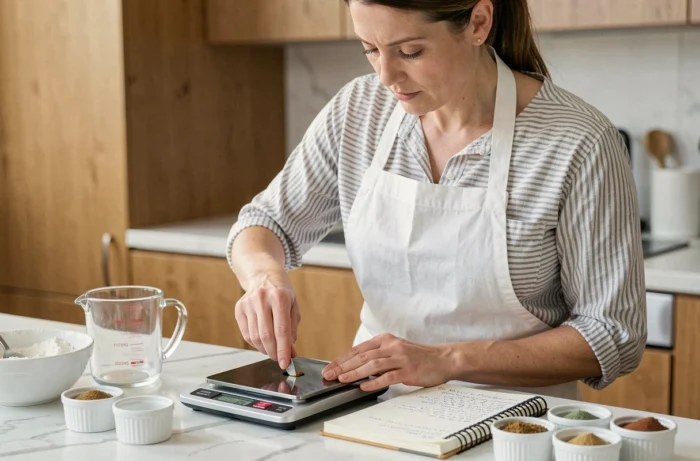
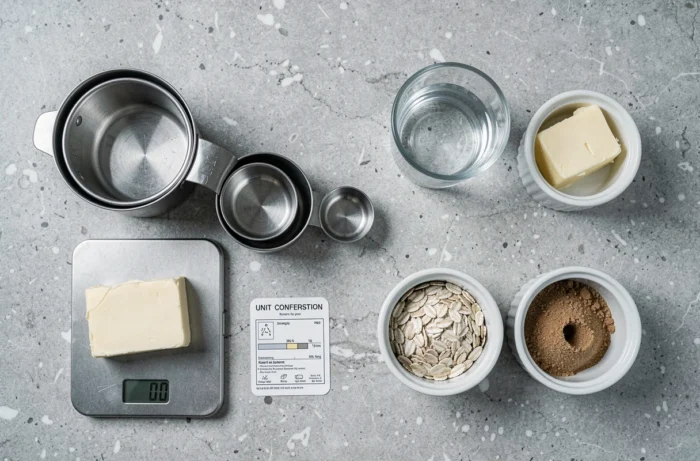
The scale remains the most reliable tool for mass conversions in cooking. It eliminates variables related to packing, container shape, and density. A measuring cup is useful for common liquids (water, milk), but it introduces a margin of error as soon as you measure viscous ingredients or powders.
Standardized teaspoons and tablespoons (5 ml and 15 ml) are a practical complement for small quantities, as long as they are leveled. A heaping spoonful of cocoa does not weigh the same as a level spoonful, and the difference is felt in the final result.
Choosing the right tool according to the ingredient and quantity, rather than measuring everything with the same container, remains the safest method to stay true to the original recipe.