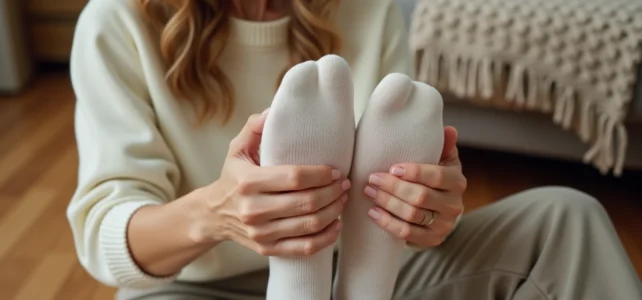
Red marks around the ankle, a feeling of constriction by the end of the day, tingling toes: a pair of socks that are too tight turns every step into irritation. The problem rarely stems from a poor purchase. Washing at too high a temperature, tumble drying, fibers that shrink over time: the causes are common, and so are the solutions.
Understanding why fibers shrink after washing
Before trying to stretch a sock, it’s important to understand what made it tighter. The fabric doesn’t shrink randomly. Each material reacts differently to heat and the mechanical agitation of the drum.
Wool felts when its scales cling to each other under the effect of hot water. Cotton, on the other hand, contracts because its fibers release the tension accumulated during weaving. Synthetic blends hold up better, but their ankle elastic can lose flexibility after dozens of cycles.
Have you ever noticed that a sock taken out of the dryer seems shorter and stiffer than before? That’s exactly this phenomenon. Heat accelerates the tightening of the fibers, especially in areas where the knitting already exerts pressure (ankle edge, arch).
To loosen tight socks, the method directly depends on the fabric composition. A wool sock is not treated the same way as a cotton blend sock. Keeping the composition label handy before attempting anything avoids unpleasant surprises.

Warm water and fabric softener method to soften fibers
The most accessible technique requires only a basin, warm water, and a capful of fabric softener. The principle is simple: the fabric softener releases the tension between the fibers and allows them to be stretched manually without damage.
Concrete steps
- Fill a basin with warm water (never hot) and add a capful of fabric softener. Let the pair of socks soak for about twenty minutes.
- Remove the socks without wringing them out. Gently stretch them lengthwise and widthwise, focusing on the ankle and instep areas.
- Slide each sock over a cylindrical object (a plastic bottle, a jar, a rolling pin) to maintain the stretch while air drying.
Dry flat or on a support, never in the dryer. Putting the sock back in the drum after this treatment would undo all the stretching work.
This method works particularly well on cotton and cotton-polyester blends. For wool, replacing the fabric softener with a tablespoon of white vinegar yields better results because vinegar softens the fiber without felting it further.
White vinegar on wool: why it works
White vinegar is acidic. When applied to wool, it relaxes the scales of the fiber that have closed up during washing. The sock regains some of its original flexibility.
The process is identical to the previous method: soaking in warm water mixed with white vinegar, manual stretching, then drying on a support. Never rub or twist a wool sock during this operation. Wet wool is fragile and can deform irreversibly if mishandled.
A point often overlooked: white vinegar also removes detergent residues that stiffen the fabric over time. A sock that seems to have shrunk may have simply accumulated limescale and soap in its fibers.
Mechanical stretcher: a more precise alternative
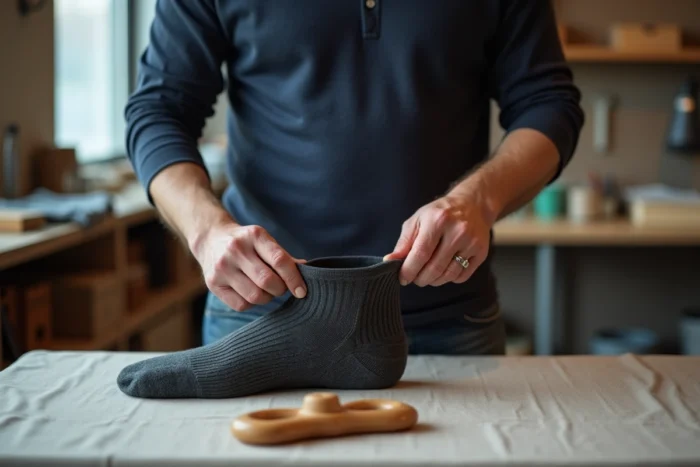
Several manufacturers now market mechanical devices designed to locally stretch socks and shoes. These devices apply a gradual and controlled pressure on the area to be loosened, resulting in a more uniform outcome than manual stretching.
The main advantage is repeatability. While manual stretching yields variable results depending on the force applied, the mechanical stretcher allows for precise control of the tension. For a pair of compression socks that have become uncomfortable after several washes, this type of tool avoids the need to buy a new pair.
These devices are especially suitable for thick socks (sports, hiking, compression). On a thin nylon sock, the risk of tearing is real. It’s better to reserve the manual method for lightweight materials.
Preventing socks from becoming too tight again
Loosening a sock is pointless if the next wash tightens it again. A few simple habits can preserve the regained fit.
- Wash socks in cold or warm water, never above 30 °C for wool and 40 °C for cotton.
- Avoid the dryer altogether. Air drying, flat on a towel, maintains the size and elasticity of the fiber.
- Store socks flat rather than rolled into a ball. Balling them up deforms the ankle elastic over time.
- Choose the right size at purchase: a sock that is too small by one size will not “stretch” to fit like a leather shoe.
The fabric composition directly influences the durability of the fit. Blends containing elastane hold their shape better than pure cotton, which tends to gradually contract.
The specific case of compression socks
Since the decree of June 26, 2026, state-certified nurses can prescribe and renew venous compression socks. If your pair of compression socks is excessively tight, a healthcare professional can now assess the fit and adjust the compression level without waiting for a medical appointment.
Attempting to stretch a medical compression sock on your own remains delicate. Altering the pressure exerted by the fabric can reduce therapeutic effectiveness. It’s better to have the size and compression level checked before making adjustments.
The comfort of a sock comes down to a few things: the right fiber, the right wash, the right drying. When the damage is done, a basin of warm water and twenty minutes of patience are usually enough to regain a proper fit.