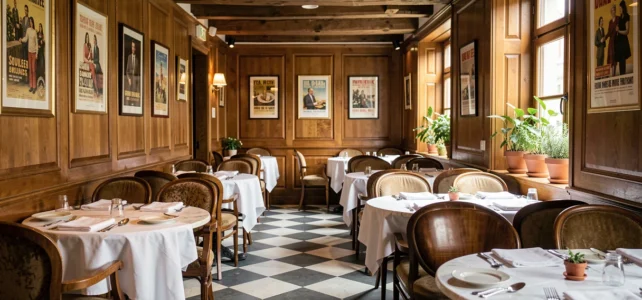
When you push open the door of a village bistro in southern Ardèche, you rarely expect to find a kitchen that works with raw ingredients with such precision. La Cigale et la Fourchette, located in Larnas, is one of those places that blurs the line between a country restaurant and a chef’s table. The venue acts as a revealer of what the region produces best, without detours or artifice.
Short Supply Chains in Ardèche: The Larnas Model
Larnas is a village of a few hundred inhabitants, perched on a limestone plateau between the gorges of Ardèche and the Rhône valley. There are no large stores nearby, no food wholesalers accessible within five minutes. For a restaurateur, this geographical constraint naturally pushes them towards local producers.
La Cigale et la Fourchette fits into this logic of extremely short supply chains, often without intermediaries. We are talking about market gardeners, breeders, and winemakers located just a few kilometers away, sometimes even in the village itself. This approach is not a marketing argument slapped onto a menu: it is a practical necessity linked to the restaurant’s location.
This locavore positioning takes on particular significance when linked to the dynamic of small evening summer markets that have multiplied in Ardèche villages over several seasons. According to the Aubenas-Vals tourist office, these markets showcase “very small productions or things they usually keep for family.” The restaurant draws from this same pool of micro-farming productions, those that never make it to a conventional stall.
To learn more about La Cigale et la Fourchette, the establishment’s website details its commitments and partner producers.
Gourmet Specialties of La Cigale et la Fourchette: What Arrives on the Plate
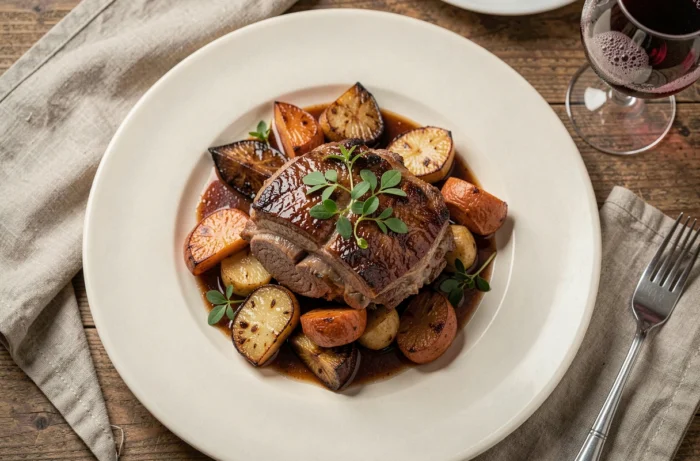
The menu is based on French cuisine crafted from organic and local products. The restaurant is listed as a country bistro, a designation in Ardèche that refers to establishments engaged in village life and in promoting the culinary know-how of the region.
Feedback from diners on Tripadvisor (the restaurant holds a Travellers’ Choice award there) regularly highlights the freshness of the dishes and the consistency between what is advertised and what is served. There are dishes that adapt to the seasons and arrivals, which means a changing menu rather than a fixed one for twelve months.
Key Products from the Ardèche Plateau
- Local goat cheeses, omnipresent in southern Ardèche cuisine, served as starters or incorporated into cooked dishes
- Field vegetables grown on the limestone plateau, where the dry and sunny climate yields concentrated flavors
- Wines from the Ardèche hills, often from family estates that practice organic or sustainable agriculture
- Cured meats and extensive farming meats, typical of the small-scale operations in the area
What sets this table apart is the absence of products from afar when the region can supply. Feedback varies on portion sizes or the pace of service, but the quality of the ingredients is a constant point in reviews.
Country Bistro in Larnas: A Role Beyond Dining
The “country bistro” label is not just a tag. In a village like Larnas, the restaurant serves as a place for collective life. People come to eat, but also to have a coffee, meet locals, and learn about local events.
La Cigale et la Fourchette offers wide hours, with openings covering lunch and dinner most days of the week. The restaurant is closed on Wednesdays. The terrace, available high chairs, and wheelchair accessibility show a desire to welcome all audiences, from families on vacation to hikers passing through the gorges.
A Connection to the Tourist Fabric of the Ardèche Gorges
Larnas is located in direct proximity to the Ardèche gorges and the Pont d’Arc, one of the most visited natural sites in the region. For visitors canoeing down the gorges or exploring the Chauvet cave, the village offers a stop away from the hustle and bustle of more touristy towns like Vallon-Pont-d’Arc.
The restaurant attracts this passing clientele while maintaining its local base. This dual function, rare in very small villages, partly explains the consistency of positive reviews on platforms: the expectations of locals and tourists converge on product quality.
Organic Cuisine in Ardèche: What the Label Changes Concretely
Displaying “organic” on a storefront has become common. What matters is the actual traceability of supplies. In the case of La Cigale et la Fourchette, the short supply chain makes this traceability clearer than in an urban restaurant that orders from a certified wholesaler.
When the market gardener is ten minutes away by car and the restaurateur knows their plots, the notion of organic takes on a concrete meaning. You know what has been planted, how, and when. This level of transparency is difficult to reproduce outside of a rural area structured around small farms.
The rise of quality audits like Gault and Millau in local restaurants reflects this evolution: gastronomic guides are now interested in engaged rural bistros, not just starred tables in big cities. For an establishment like the one in Larnas, this gradual recognition validates a model that has existed on the ground for years.
The story of La Cigale et la Fourchette is intertwined with that of its village and its producers. No grand founding narrative, no media chef: a sincere cuisine, rooted in a limestone plateau where cicadas indeed sing louder than anywhere else.