
A bride-to-be who walks into a bridal showroom without reading the terms and conditions on the order form risks losing the amount she has paid if she changes her mind. In France, advance payments to a professional are generally considered deposits (arrhes) if the contract does not specify their nature. Preparing to contact a bridal boutique starts with gathering the right information before making a financial commitment.
Deposits, down payments and cancellations: how the order form affects your wedding dress
Before even discussing style or budget, it helps to understand a legal point that most wedding blogs overlook. When a boutique asks for a payment to start an order for a dress, the nature of that payment determines your rights if you cancel.
If the order form specifies a deposit (arrhes), the customer forfeits the amount paid if she cancels, but the boutique must refund twice that amount if it cancels. If the document refers to a down payment (acompte), both parties are committed: the boutique can claim the full balance, and the customer cannot withdraw without negotiating.
So before signing anything, check the exact wording on the document. You can contact La Perle – Une Maison De Mariée to ask about this during your first conversation, by email or phone.
This detail becomes especially important if, in the meantime, you find a second-hand wedding dress or one on an online platform. Finding an alternative after paying a boutique does not automatically entitle you to a refund. Without a written cancellation clause, money paid in store remains with the seller when it is a deposit (arrhes), and the situation is even more complicated with a down payment (acompte). It is best to ask about the cancellation terms before making any payment.
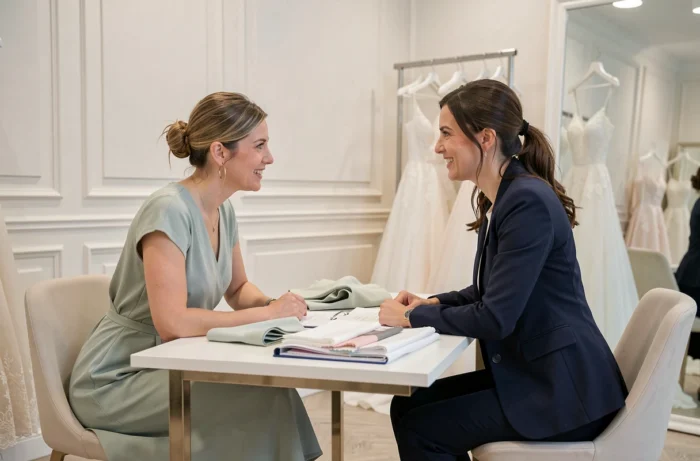
Wedding dress budget: questions to ask before your first appointment
Everywhere you look, you’ll read that you should “set your budget” before contacting a boutique. It’s good advice, but too vague. What matters is knowing exactly what the budget covers at each bridal boutique.
Some boutiques include alterations in the listed price. Others charge separately for each adjustment (hemming, bodice alterations, adding straps). The veil, belt or petticoat may also be presented as an extra-cost accessory. Ask in writing what is included in the quoted price before you visit.
Here are some specific points to raise during your first contact:
- Does the listed price cover basic alterations (hemming, waist adjustment), or are they charged separately?
- Are key accessories (veil, petticoat, belt) included or offered as optional extras?
- Does the boutique offer after-sales services (cleaning, alterations, preservation), and how much do they cost?
- What is the usual order lead time, and is there an extra charge for an urgent order?
Asking these questions by email before your appointment can prevent you from falling in love with a dress whose final cost exceeds your budget by several hundred euros.
New or second-hand wedding dress: compare your options before committing
The second-hand wedding dress market is becoming more established. A report published by Actu.fr in November 2026 describes a Normandy showroom specializing in pre-owned dresses, with appointments for fittings and a consignment system. This type of brick-and-mortar boutique lets you try on dresses in conditions similar to those at a traditional bridal boutique.
If this option appeals to you, include second-hand dresses in your comparison from the outset, before paying anything at a traditional boutique. Once you have signed a down payment agreement (acompte), changing your mind becomes a legal issue, not just a simple change of heart.
First contact with a bridal boutique: an email that gets a quick reply
Bridal boutiques receive dozens of inquiries each week, especially between January and April. A vague email (“I’m looking for a dress, what are your prices?”) often ends up at the bottom of the pile.
An effective first message takes five or six lines and includes four specific details:
- Your wedding date (or the time of year you have in mind), so the boutique can assess the order lead time
- The style you’re looking for (cut, fabric, length), even if you describe it simply: “a flowing crepe dress with no train”
- Your budget range, so the advisor can point you directly to suitable designers or collections
- The contractual question you’re concerned about (deposit or down payment, alterations included, cancellation policy)
There’s no need to tell the story of your relationship or describe the reception venue’s decor. The boutique needs specific details to prepare for a useful appointment.
In-store cancellation rights: a misconception to forget
You often hear about the “14-day cooling-off period.” This rule applies to distance or off-premises contracts, not to a purchase made directly in a store. Dresses made or personalized to order are also subject to exceptions.
In practical terms, if you sign an order form in a boutique for a made-to-measure or specially ordered dress, there is no automatic statutory cooling-off period. Your only protection is what is stated in writing in the contract. Ask the bridal boutique to specify in writing which rules apply to your order.

Preparing to contact a bridal boutique means asking about contractual and budget matters before getting swept up in the emotion of trying on dresses. The type of payment (deposit or down payment), exactly what the price includes, and the lack of in-store cancellation rights are three points that matter just as much as choosing the dress itself.