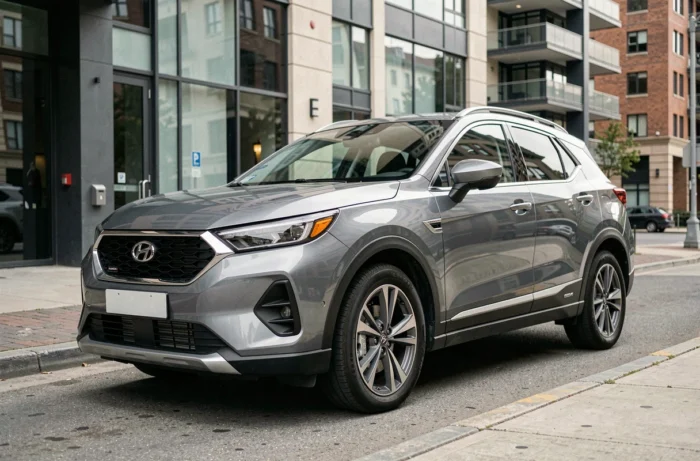
The hybrid SUV market in France now spans a wide range, from small urban crossovers to large seven-seat models. Hybrid systems themselves vary (full hybrid, plug-in hybrid, mild hybrid), and their real-world benefits depend directly on how the vehicle is used. A poor match between vehicle size, hybrid type and daily driving habits can cancel out the economic or environmental benefits of hybrid power.
Rechargeable battery and third row: a trade-off that is often misunderstood
One of the least obvious issues at the time of purchase is the physical conflict between a plug-in hybrid’s battery and interior space. In several large premium SUVs, the battery (15 to 25 kWh) takes up the space beneath the boot floor, exactly where the third row folds away in combustion-engine versions.
The result: models such as the Audi Q7 55 TFSI e, BMW X5 xDrive50e and Mercedes GLE 350 de go from seven seats to five in plug-in hybrid form. The same pitfall can arise on the used-car market, where a listing may say “7 seats” because it has been confused with the combustion-engine version. Section S.1 of the registration certificate is the only reliable document for checking the actual number of seats.
The Volvo XC90 T8 Recharge is an exception: it retains seven seats as standard in plug-in hybrid form, with a genuinely usable third row for two passengers. It is one of the few premium models to solve this equation, as explained in Clic Auto’s guide, which compares options by driver profile.

Compact hybrid SUVs: who they suit and where their limits lie
Compact hybrid SUVs (Renault Austral, Peugeot 3008, Toyota C-HR) are designed for urban and suburban driving. Their size makes parking easier, and their combined-cycle fuel consumption remains modest compared with heavier models.
Their limitations become apparent as soon as you load the vehicle. Boot space is smaller than in a family SUV, and the rear bench can be a tight fit for three adults on long journeys. The format works well for a couple with one or two young children. Beyond that, space can become a real source of everyday friction.
Full hybrid or plug-in hybrid in a compact SUV
In a compact SUV, a full hybrid is often enough for mixed city and road driving. The extra cost of a plug-in hybrid is only worthwhile if most daily journeys fall within the model’s electric range and you have regular access to a charging point at home or work. Without frequent charging, a plug-in hybrid runs mainly on fuel while carrying a heavier battery, which increases consumption compared with a conventional hybrid.
Plug-in hybrid family SUVs: when charging makes all the difference
Family SUVs (Ford Kuga, long-wheelbase Renault Austral, Toyota RAV4) occupy the middle ground. They offer a larger boot and a comfortable rear bench for three passengers, without the complexity of a third row.
The Ford Kuga stands out for its factory compatibility with Superethanol-E85. This Flexifuel hybrid powertrain eliminates any reliance on electric charging and can reduce fuel costs depending on local prices. It is a worthwhile alternative for high-mileage drivers without access to a charging point.
For other plug-in models in this segment, cost-effectiveness depends on one simple factor: how often you actually charge determines the cost of ownership. A plug-in hybrid charged every evening from a domestic socket can cover a significant share of daily journeys in electric mode. The same vehicle, never charged, uses more fuel than an equivalent full hybrid because of the battery’s extra weight.
- Commute shorter than the model’s electric range, with access to a charging point: a plug-in hybrid makes perfect sense, with a cost per kilometre close to that of a fully electric vehicle on these journeys.
- Regular long journeys (motorway driving, more than 100 km per day) with no opportunity to charge along the way: a full hybrid or E85 Flexifuel offers better value for money and fuel economy.
- Mixed use with occasional charging: a plug-in hybrid still offers some benefits, but they are modest, and it can take several years to recoup the higher purchase price.

Crit’Air stickers and low-emission zones: a localised buying consideration
A hybrid SUV’s Crit’Air classification does not depend on the word “hybrid” in its specifications, but on its fuel type and date of first registration. Recent petrol hybrids are classified as Crit’Air 1, while older diesel hybrids may fall into a more restrictive category.
Access rules for low-emission zones vary from one metropolitan area to another. In Strasbourg, the Eurométropole extended the educational phase for Crit’Air 3 vehicles, while Crit’Air 4, 5 and unclassified vehicles remained banned under the order in force in October 2026. These kinds of local adjustments make it impossible to give a single answer to the question, “Will my hybrid be allowed to drive everywhere?”
Before buying, it is worth checking the low-emission zone order and planned timetable for your metropolitan area, not just the sticker classification of the model you are considering. A Crit’Air 1 vehicle can currently drive without restrictions in all active low-emission zones, but local timetables can change independently of the national framework.
Choosing between size and hybrid technology: three typical profiles
The choice comes down to two factors: how many people regularly travel in the vehicle and whether charging is a practical option.
- Couple or family with one child, mostly urban driving: a compact full hybrid meets the need without unnecessary extra cost. A plug-in hybrid only offers an advantage if a charging point is available every day.
- Family of four, mixed city and road driving: a family plug-in hybrid charged regularly offers the best balance of space, fuel consumption and running costs. Without charging, the Ford Kuga Flexifuel E85 is a credible alternative.
- Large family or occasional need for seven seats: the Volvo XC90 T8 remains the benchmark for a seven-seat plug-in hybrid. Most other seven-seat hybrid SUVs are mild hybrids, which do not offer an electric-only mode but retain the third row.
The hybrid SUV segment is about more than a list of models ranked by price. The useful question is not “What is the best hybrid SUV?” but rather which type of hybrid technology suits your actual journeys, and what size of vehicle your daily routine really requires. A well-chosen compact SUV will cost less to buy and run than an oversized family model whose plug-in battery never gets connected to a charger.