A parcel returned to sender, a registered letter missing for several days: in most cases, the problem is an incorrectly written postal address. Since the 3DS law came into force, all French municipalities must create and publish a local address database that feeds into the National Address Database (BAN). This requirement changes things: an address that worked two years ago may have been changed by the town hall without your knowledge.
Check for a municipal street-numbering change before sending mail
Have you ever noticed that mail takes longer to arrive after moving within the same neighborhood? Sometimes the cause is a renumbering decided by the municipality, not a mistake on your part.
Under the 3DS law, each municipality publishes its addresses in the BAN. Addresses are listed as certified or undergoing certification. A newly assigned number may not yet appear in carriers’ or e-commerce sites’ systems.
To find out whether your address is up to date, check the BAN online (adresse.data.gouv.fr) or contact your town hall. A number certified in the BAN is guaranteed to be recognized by postal operators. If its status is “undergoing certification,” notify your regular senders and include the previous number in parentheses on your mail until the update is complete.
Understanding the format of a French postal address helps you spot discrepancies between the address approved by the municipality and what databases still show.
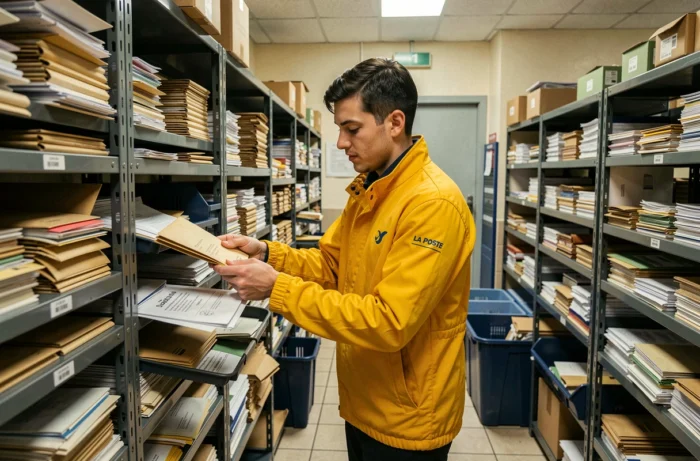
The six lines of a postal address that complies with La Poste standards
French postal standards structure an address in a maximum of six lines. Each line has a specific purpose, and their order cannot be changed.
- Line 1: recipient’s identity (title, first name, last name, or company name). This is the first line the postal worker reads to confirm the mailbox.
- Line 2: additional identification or delivery point (apartment, floor, department, “c/o Mr. Dupont”). Useful in apartment buildings or businesses with multiple departments.
- Line 3: street number and name. The number always comes before the street type (street, avenue, road), followed by the name. “Bis” or “ter” is attached to the number without a comma.
- Line 4: additional location details (locality, hamlet, residence, building). This line is omitted in city centers but is necessary in rural areas.
- Line 5: postal code and municipality, with the municipality in uppercase. The five-digit postal code directs the mail through automated sorting.
- Line 6: country, only for mail sent from abroad.
Leaving a line blank if it does not apply to you is not a problem. Adding information on the wrong line, however, slows down automated sorting.
Address-writing mistakes that can actually prevent delivery
Some mistakes go unnoticed when writing an address but cause real problems at sorting centers or during the postal worker’s delivery round.
Postal code and municipality do not match
An incorrect postal code sends mail to the wrong sorting center. The parcel then goes to another town before being redirected, adding several days to the delivery time. Always check that the postal code matches the municipality, especially in areas where several municipalities share a similar prefix.
Abbreviated or misspelled street name
“Bd” for boulevard or “Av.” for avenue are understood by sorting machines. However, a typo in the proper name of the street (writing “Descartes” instead of “Descartres,” for example) may be enough to prevent automatic recognition. Copy the street name exactly as it appears on the street sign or in the BAN.
Missing details for apartment buildings
In apartment buildings, the street number alone is not enough. Without a building, stairwell, or floor number, the postal worker will leave a delivery notice because they cannot identify the mailbox. Newer residential complexes with multiple buildings are particularly affected.
A well-written address is not necessarily a validated address
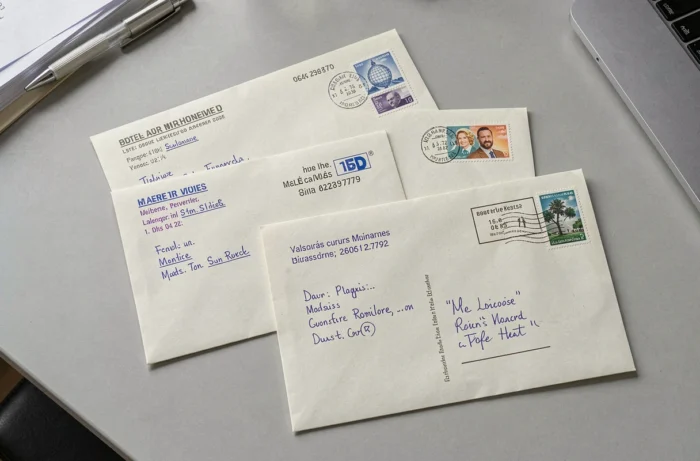
You can follow the six-line format to the letter and still run into a delivery problem. Many senders overlook the distinction between formatting and validation.
Professionals use a process called RNVP (restructuring, standardization, and postal validation). It involves three steps: putting the details in the correct order, standardizing them according to postal abbreviations, then checking the address against official reference databases to confirm that it exists. An address that is neatly formatted but missing from the reference database will be rejected by automated systems.
For individuals, the easiest way to check is to enter the full address in the BAN. If an exact match appears, the address is recognized. If the result is approximate or no result appears, contact the town hall to confirm the official wording.
Access to the delivery point: the postal worker needs more than an address
Even a perfectly written address can cause problems if the mailbox is inaccessible. La Poste documents on last-mile delivery difficulties mention several practical obstacles: a mailbox too far from the public road, a name missing from or illegible on the mailbox, an untrimmed hedge blocking access, or an unsecured dog.
Place your mailbox at the edge of a road open to public traffic, in accordance with the interministerial order of June 29, 1979. Write the names of everyone in the household on it in legible letters. If the postal worker cannot find the recipient’s name on the mailbox, the mail will be treated as undeliverable.
In rural areas with a named locality, add a marker visible from the road (a sign or a number painted on the gate). A substitute postal worker who is unfamiliar with the route relies directly on it.
A postal address is more than the six lines printed on an envelope. It connects a municipal reference database, an automated sorting system, and a physical delivery point. If any one of these three links is missing, delivery will fail, no matter how carefully the others are handled.